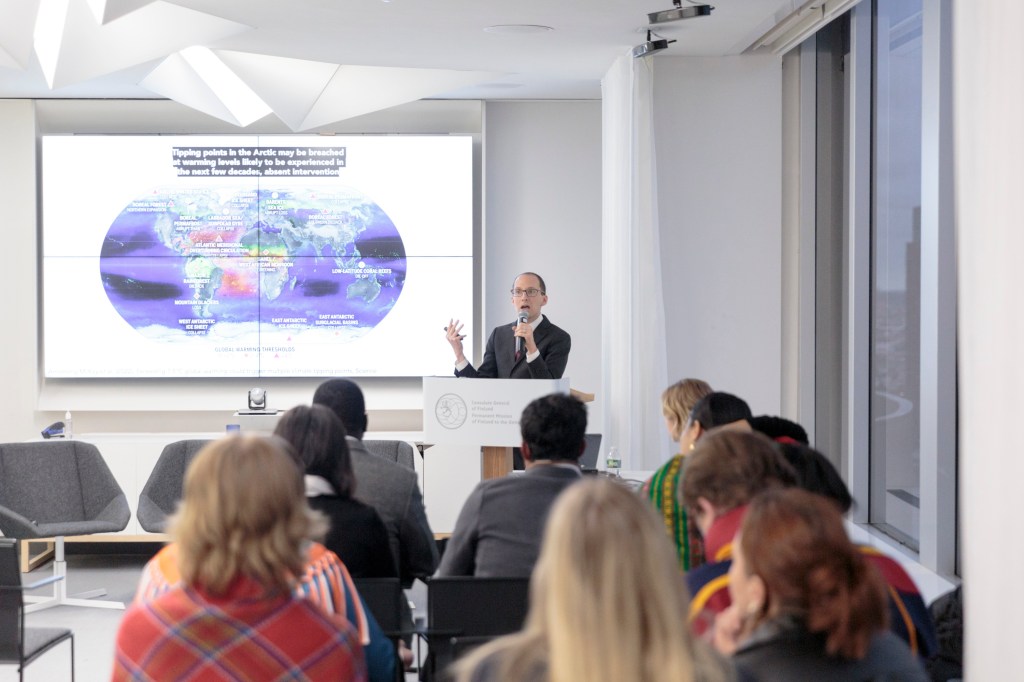
Full video of the “Sharing Sámi Experiences: Indigenous Voices on Climate Intervention Research” event hosted by the the Sámi Parliament of Finland, in partnership with Operaatio Arktis, SilverLining, and Green Africa Youth Organization, at the Permanent Mission of Finland to the United Nations.
It was very exciting to participate in the “Sharing Sámi Experiences: Indigenous Voices on Climate Intervention Research” event at the Permanent Mission of Finland to the United Nations! Many thanks to the Sámi Parliament of Finland, SilverLining, Green Africa Youth Organization (GAYO), and Operaatio Arktis for organizing and for the invitation to speak about climate intervention research. I learned a lot about the role indigenous peoples in general and the Sámi in particular can play in advancing responsible research into climate solutions and the importance of including their perspectives from the start, and I look forward to continuing this important conversation.
18 APR 2024, MANHATTAN, NEW YORK: Permanent Forum of Finland. CREDIT: SARAH BLESENER
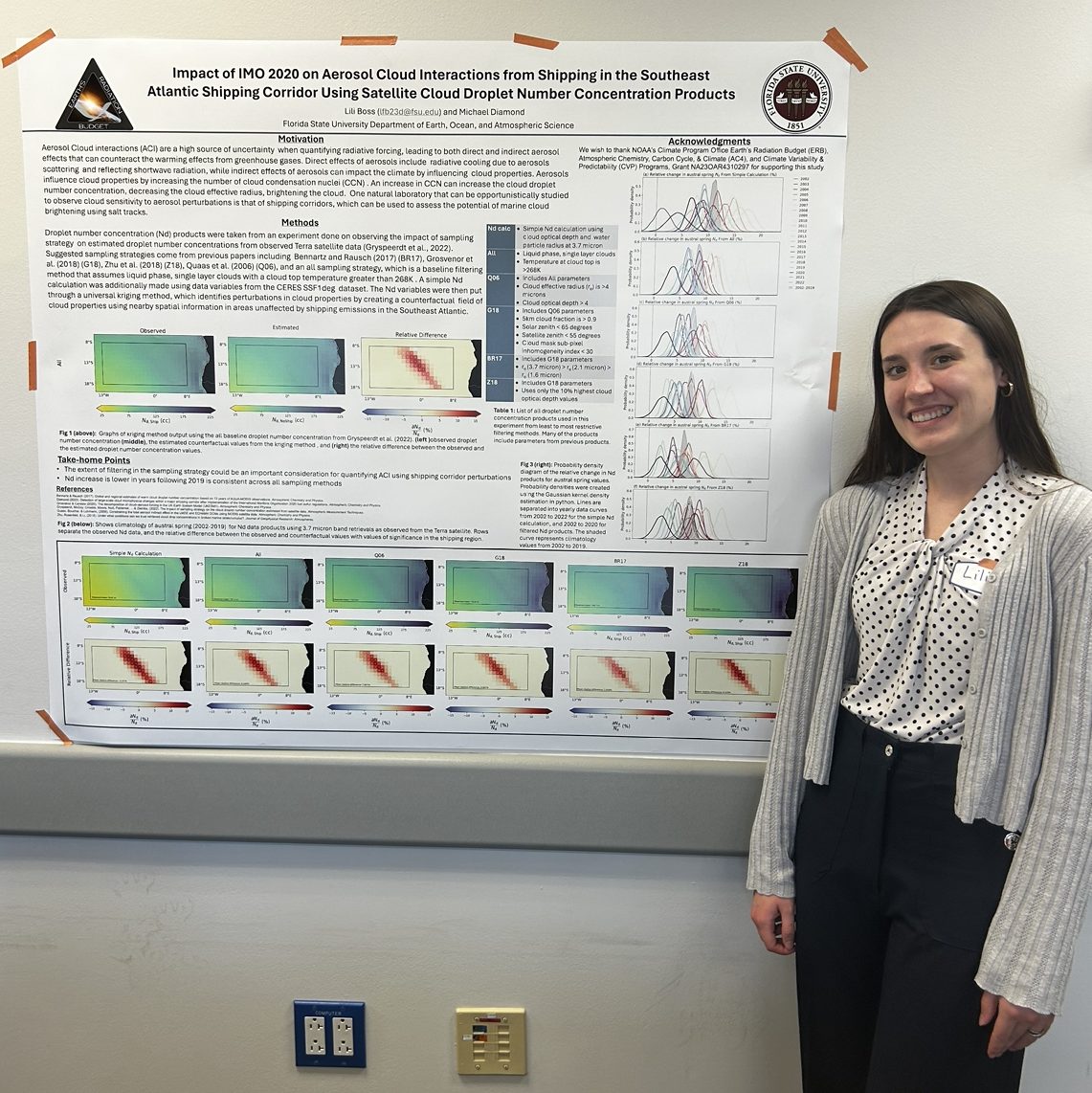
Lili had the opportunity to present her recent results at the University of Florida’s Air Quality Workshop. Lili’s research has involved investigating how different methods for calculating cloud droplet number concentration can impact the observed signal of a major shipping corridor in the Southeast Atlantic before and after changes to international regulations on sulfur content in shipping fuels. Her findings suggest that while all filtering methods consistently show changes to the increase of droplet number concentrations in the years following the shipping regulation, the relative difference is large enough between the sampling methods that the filtering used to calculate droplet number concentration is an important consideration for quantifying aerosol-cloud interactions.
Figure 1 from Diamond (2023), showing that strong cloud perturbations from ship pollution before the IMO 2020 marine fuel sulfur regulations largely disappear after their implementation. Shading shows the size of cloud droplets forming in the region.
The ACP Paul Crutzen Award “was created to recognize an outstanding publication in ACP that advances our understanding of atmospheric chemistry and physics. The annual award was created in honour of Paul Crutzen, Nobel Prize laureate and former director of the Max Planck Institute for Chemistry, who played a pivotal role in the creation of the journal 22 years ago.”
In 2020, international law imposed strong restrictions on sulfur emissions from the international shipping industry. In this study, sophisticated statistical techniques were used to compare cloud droplet size and reflectivity before and after the law was implemented, finding strong evidence that droplet sizes have increased and that clouds have darkened, resulting in a significant local warming effect. In addition to their geophysical significance, the results provide independent evidence for general compliance with the 2020 regulations. The award committee described the paper as innovative and timely, with high societal relevance.
Figure. Illustrative climate model results showing that although solar climate intervention (yellow line) can reduce global average surface temperatures (a) from a high greenhouse gas emissions scenario (red line) to that from a lower greenhouse gas emissions scenario (blue line), doing so would over-correct and decrease precipitation (b) and would not substantially ameliorate ocean acidification (c).
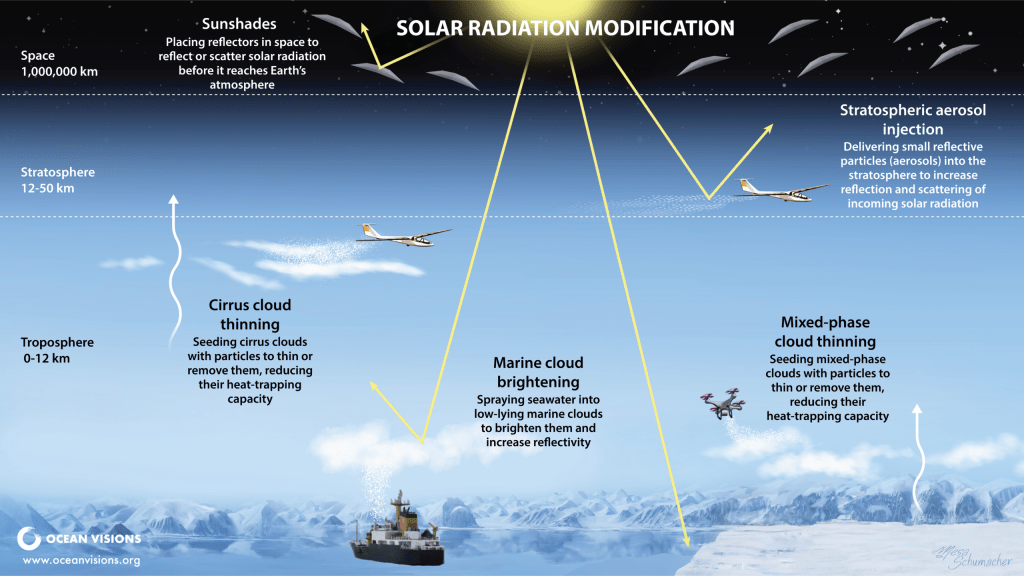
Despite substantial progress in clean technology and increasing policy ambition, the world remains off track to hold warming to the Paris Agreement targets of well below 2 °C and no greater than 1.5 °C above pre-industrial temperatures. In light of this, a growing number of scientists and advocates have called for expanding research into solar climate interventions that would utilize tiny solid or liquid particles suspended in the atmosphere (aerosols) to reflect more sunlight away from Earth and thus offset some of the effects of global warming due to greenhouse gas emissions from fossil fuel burning and deforestation.
Notwithstanding the relatively early state of solar climate intervention research, at least one company has already been founded to market “cooling credits” that purport to offset a given quantity of greenhouse gas emissions with the emission of aerosols or their precursor gases. In the near-term, the science of solar climate intervention is simply too uncertain for such credits to be meaningful market instruments. More fundamentally, however, many of the climatic and environmental effects of greenhouse gas emissions are incommensurate with those from aerosol injections. If solar climate interventions are to be part of society’s portfolio of responses to climate change, they must be complements to, not substitutes for, mitigation. A market approach to solar climate intervention based on “cooling credits” is not a viable climate solution.