NASA’s ORACLES (ObseRavations of Aerosols above CLouds and their intEractionS) aircraft campaign is studying how smoke from fires in southern Africa affect clouds over the southeast Atlantic Ocean. This area is poorly represented in climate models, but the interactions between the clouds and smoke can cause large changes in the region’s energy balance which will either warm or cool the area. The measurements we take of the smoke and cloud properties over the ocean will help us to better understand this system and the interactions between clouds, pollution, and climate more generally.
Check out espo.nasa.gov/oracles for more ORACLES-related information.
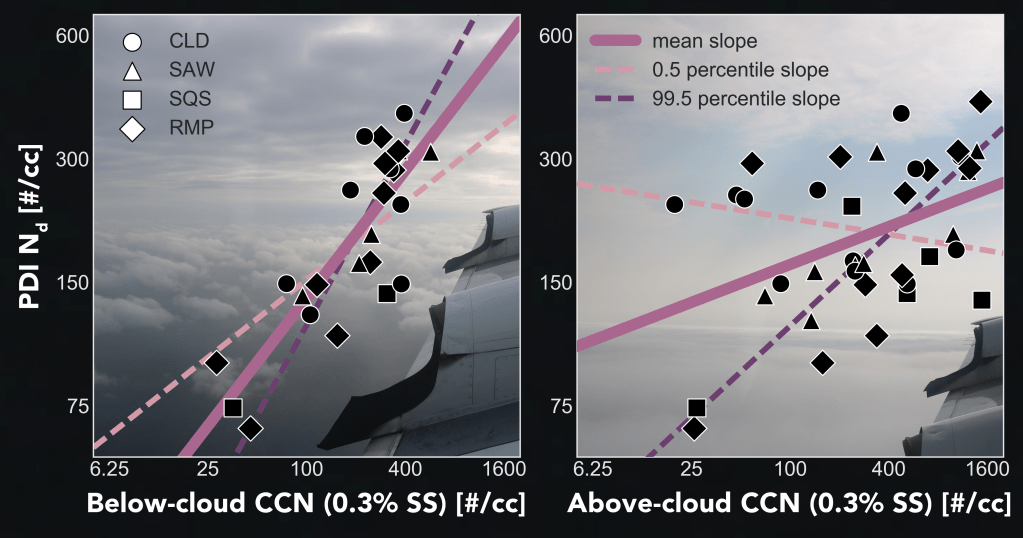
In Diamond et al. (2018), we investigate how this smoke from biomass burning in Africa can mix into clouds over the southeast Atlantic and create new droplets. This brightens the clouds, reflecting more sunlight and thus cooling the region. Using ORACLES aircraft data, we find that cloud properties are correlated with smoke as expected when the smoke is below the clouds but not when smoke is above the clouds because it takes several days for clouds to mix smoke downward. As a result, trying to quantify aerosol-cloud interactions only using instantaneous “snapshots” of above-cloud aerosol and cloud properties, as is necessarily done in most satellite studies, can give a misleading picture of what the true effect is. We recommend “Lagrangian” methods that can track clouds as they move for future work.
For more information, check out our (open-access!) papers in Atmospheric Physics and Chemistry and my posts at the NASA Earth Expeditions and the UW Program on Climate Change blogs:
Pennypacker, Samuel, M. Diamond, & R. Wood (2020). Ultra-clean and smoky marine boundary layers frequently occur in the same season over the southeast Atlantic. Atmospheric Chemistry and Physics. 20, 2341–2351, doi:10.5194/acp-20-2341-2020
Diamond, Michael, A. Dobracki, S. Freitag, J. D. Small Griswold, A. Heikkila, S. G. Howell, M. E. Kacarab, J. R. Podolske, P. E. Saide, and R. Wood (2018). Time-dependent entrainment of smoke presents an observational challenge for assessing aerosol–cloud interactions over the southeast Atlantic Ocean. Atmospheric Chemistry and Physics. 18(19), 14623-14636, doi:10.5194/acp-18-14623-2018.
Diamond, Michael (October 2018). Chasing clouds and smoke
over the southeast Atlantic. NASA Earth Expeditions Blog. https://blogs.nasa.gov/earthexpeditions/2018/10/18/chasing-clouds-and-smoke-over-the-southeast-atlantic/
Diamond, Michael (October 2018). Fires in Africa affect clouds and climate over the Atlantic Ocean. UW Program on Climate Change Research Highlights. https://pcc.uw.edu/blog/research/fires-in-africa-affect-clouds-and-climate-over- the-atlantic-ocean/
Diamond, Michael (September 2017). Up in Smoke (and Clouds) over the Southeast Atlantic. NASA Earth Expeditions Blog. https://blogs.nasa.gov/earthexpeditions/2017/09/13/up-in-smoke-and-clouds-over-the-southeast-atlantic/
Diamond, Michael (September 2016). ORACLES in Flight. NASA Earth Observatory Notes from the Field Blog. https://earthobservatory.nasa.gov/blogs/fromthefield/2016/09/07/oracles-in-flight/

