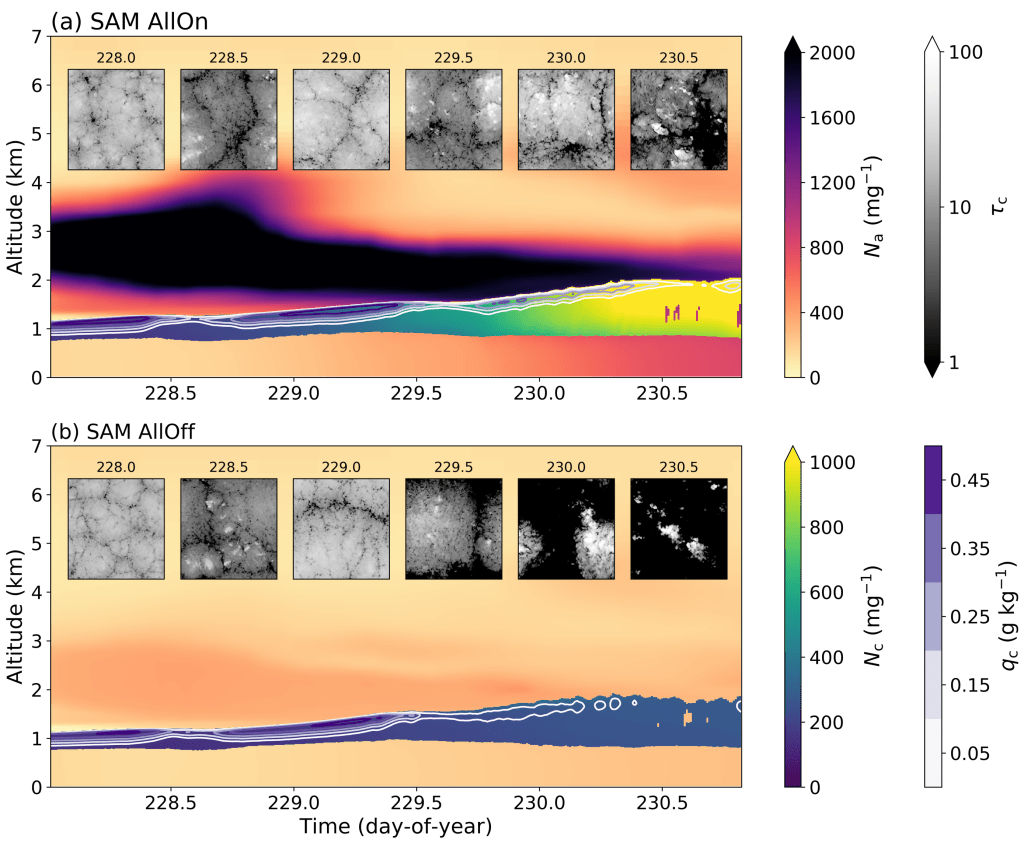
Smoke from southern Africa blankets the southeast Atlantic Ocean from June-October, overlying a major low-altitude cloud deck. I’m investigating smoke effects on the transition between overcast stratocumulus and scattered cumulus clouds along a Lagrangian (air-mass-following) trajectory in regional climate and large eddy simulation (LES; Figure 1) models.
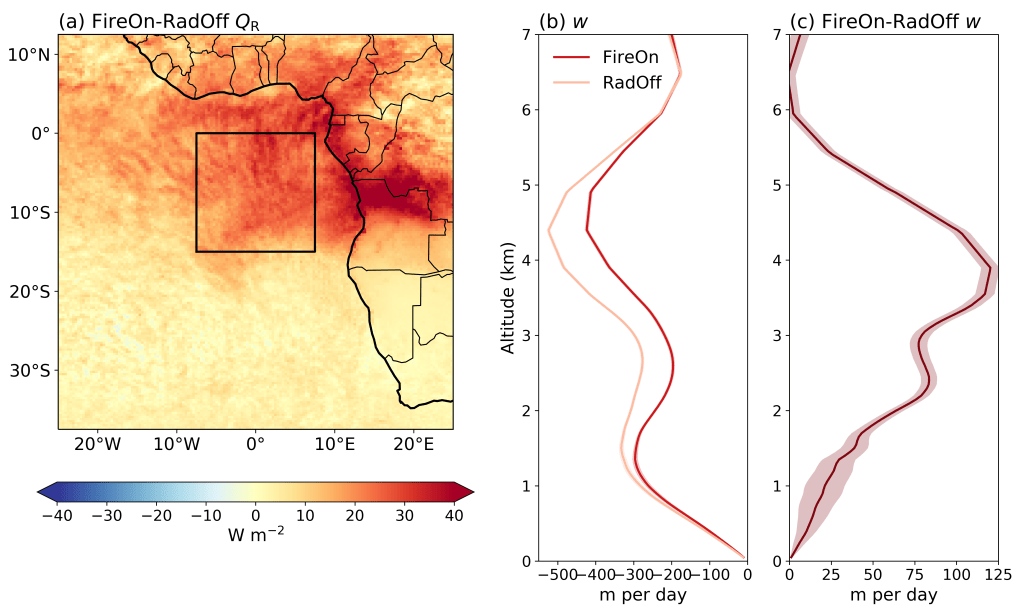
One of our major findings from the regional climate model simulations is that the absorption of sunlight by smoke over the ocean changes the large-scale circulation and reduces the sinking motion that normally characterizes air in the region (Figure 2). To our surprise, putting this effect into the cloud-resolving LES model caused a larger change in cloud properties than did including the effect of smoke in seeding additional cloud particles.
To learn more, you can check out our open-access paper published in Atmospheric Chemistry and Physics.

