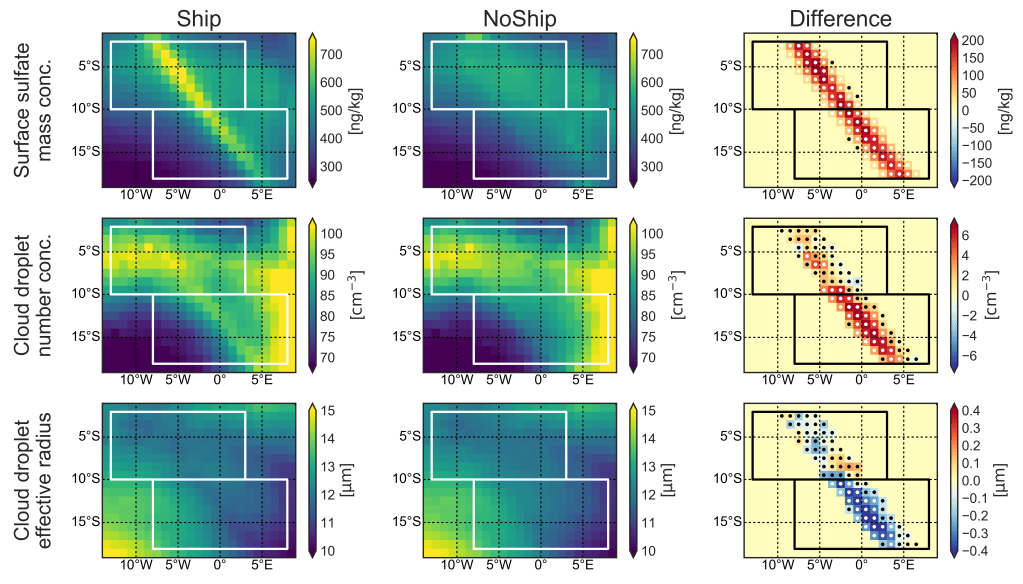
One of the biggest challenges in quantifying the human influence on Earth’s climate is understanding how small airborne particles (“aerosol”) influence cloud properties. Increasing aerosol increases the brightness of low-lying clouds, exerting a cooling effect on the climate that partially offsets some of the warming caused by increasing greenhouse gas concentrations. Ship tracks, or lines of cloud changes due to pollution from individual ships, have long been studied as a prime example of these cloud-aerosol interactions in action. Mysteriously, however, previous attempts to measure ship tracks globally found very small effects, even though climate models predict large effects. We analyzed a shipping corridor in the southeast Atlantic where the winds blow in such a way that the ships’ pollution remains constrained around the corridor. This allowed us to estimate what the clouds in the shipping corridor would look like without the effects of ships by using the properties of nearby, non-shipping-affected clouds. For the first time, we observed a substantial increase in cloud brightness caused by shipping on a regional scale. Applying cloud-aerosol relationships calculated within the shipping corridor to state-of-the-art climate model data, we estimated that pollution-induced cloud changes have offset close to a third of greenhouse-gas-driven warming since the pre-industrial era.
For more information, check out our (open-access!) paper in AGU Advances:
Diamond, Michael, H. Director, R. Eastman, A. Possner, & R. Wood (2020). Substantial Cloud Brightening from Shipping in Subtropical Low Clouds. AGU Advances, 1(1), e2019AV000111. doi:10.1029/2019av000111
For further reading, please see the University of Washington/American Geophysical Union press releases (UW/AGU) and my posts on the paper’s implications for climate change and deliberate climate interventions.

