The Diamond group’s webpage has moved to https://michael-s-diamond.github.io/camp/. This site is no longer being actively updated.
Michael speaks during 100-Hour Weather & Climate Livestream
Thanks so much to all the organizers for making this possible! To learn more about the Weather & Climate Livestream (and the importance of weather and climate data and research), check out: https://wclivestream.com/. The full livestream is available here.
Lili & Michael present work at Degrees Global Forum in Cape Town
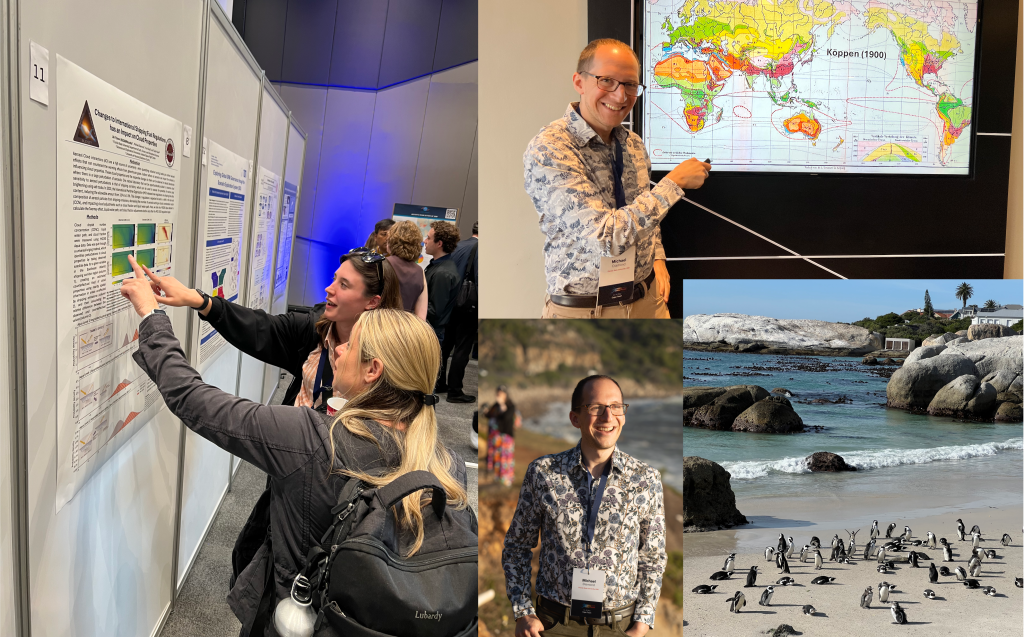
Lili and Michael travelled to Cape Town, South Africa, this May to participate in the Degrees Global Forum, which was the largest conference to date on solar radiation modification (SRM). Lili showed that whereas clouds within a shipping corridor formed more frequently and with more droplets but less liquid water before marine pollution regulations went into effect in 2020, the reduction in sulfate aerosols post-2020 has led to a reduction in all these cloud effects from shipping. Michael talked about work from undergraduate student Jay Brunelli investigating how “climate zones” (like rainforest versus savanna) shift under SRM versus unabated warming.
Lili successfully defends Masters work on how pollution regulations changed clouds
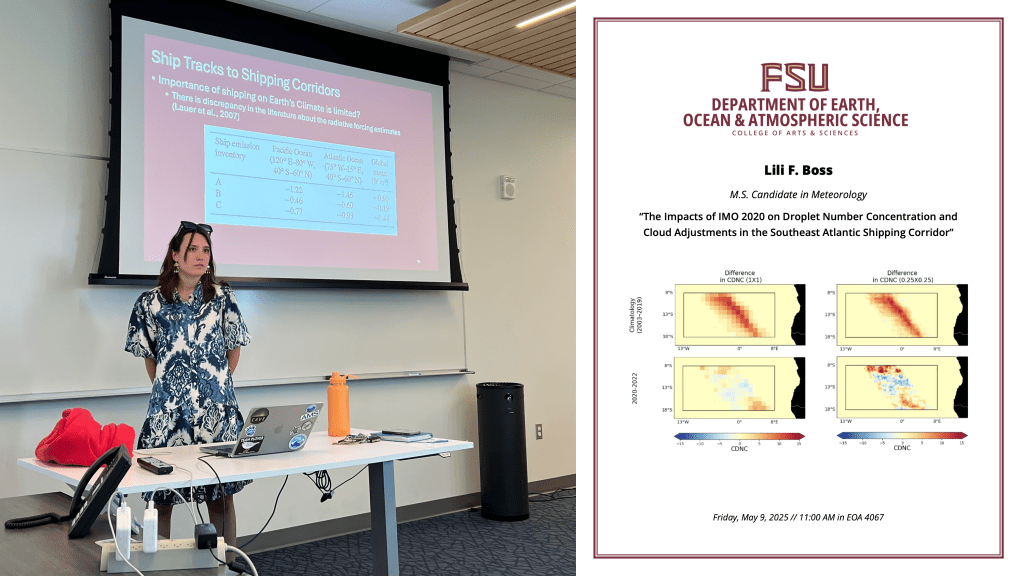
Congratulations to Masters->PhD student Lili Boss on her successful thesis defense! Lili’s work used a statistical technique called universal kriging to look at how clouds changed over a major shipping corridor in the southeast Atlantic Ocean after the International Maritime Organization implemented strict new marine fuel pollution limits in 2020. She found that while ship pollution increased the number of cloud droplets that formed and led to substantially brightened clouds before the IMO 2020 regulations, after the fuel limits the ship pollution effects were much weaker, leading to an overall cloud darkening (warming) effect. Lili also showed that changes in the amount of clouds that form were affected by ship pollution as well, although the effect differed for drizzling and non-drizzling clouds and the available data post-2020 was too noisy to draw firm conclusions about changes.
Tony successfully defends Masters work on aerosol forcing of Atlantic Multidecadal Variability
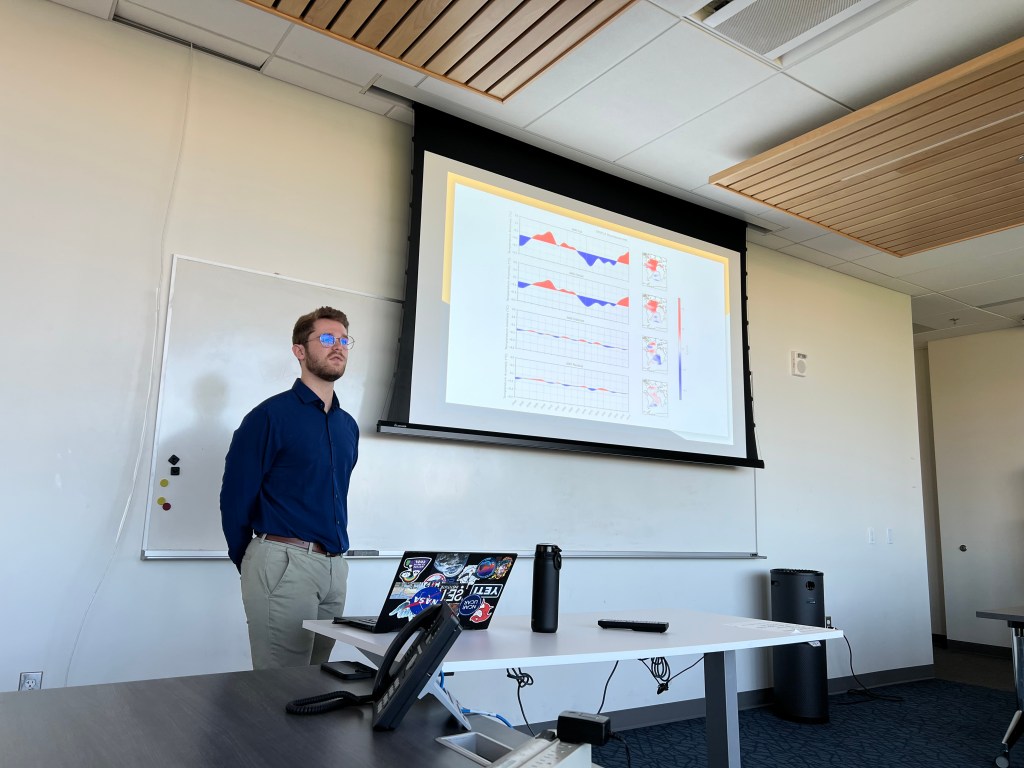
Congratulations to Masters student Tony Freveletti on his successful thesis defense! Tony’s work used a statistical technique called Low-Frequency Component Analysis (LFCA) to look at how sea surface temperatures vary over long time periods, and whether their variations are “internal” to the climate system or “forced” by human emissions of greenhouse gases and aerosols. Based on evidence from climate models and observations, Tony found that long timescale temperature variability is mostly internal in the Pacific Ocean but forced in the Atlantic. While we expect both basins to continue warming in the future, we expect that natural variability will continue to be a major factor in the Pacific whereas do we not expect natural cooling periods to offset forced warming in the Atlantic going forward.

