Michael joined the Climate Reflections podcast from SRM360, a new media organization dedicated to explaining the science behind proposed “sunlight reflection methods” for addressing global warming, for a February “News Roundup” focusing on the retirement of the Arctic Ice Project, a research roadmap for stratospheric aerosol injection and marine cloud brightening from the World Climate Research Programme, legendary climate scientist James Hansen’s new paper, and more. You can listen on the SRM360.org website or wherever you get your podcasts.
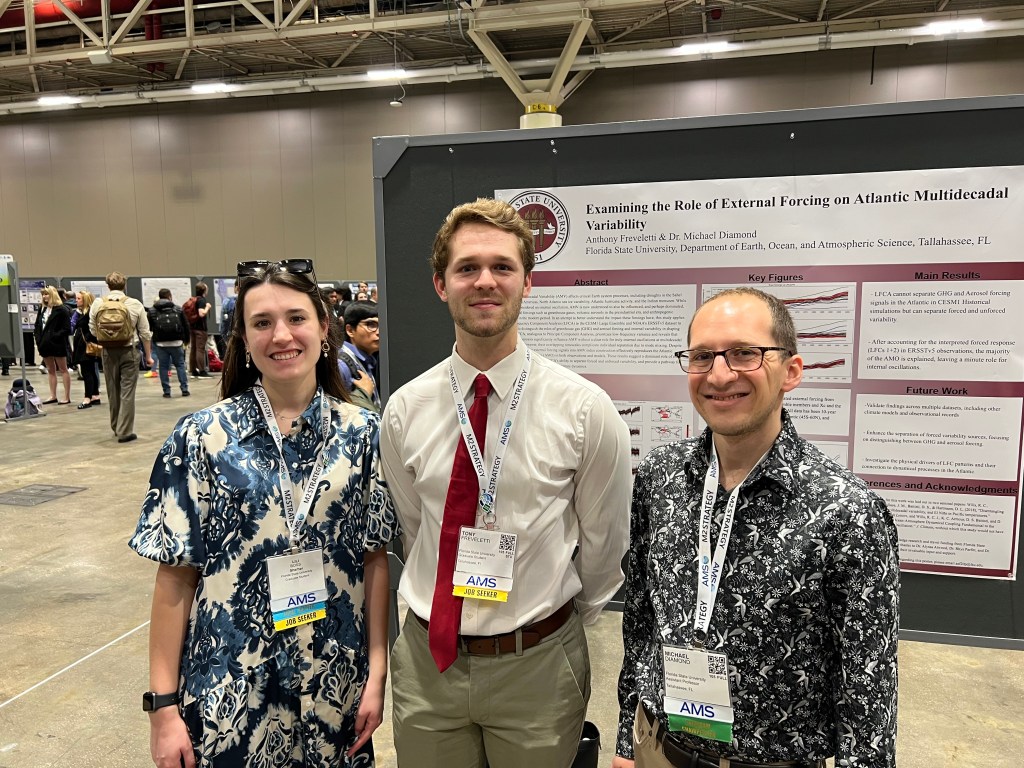
The ClaµD group at FSU was out in full force at the 2025 American Meteorological Society Annual Meeting in New Orleans, LA, with PhD student Lili Boss giving her first conference talk and Masters student Tony Freveletti presenting his first poster!
Lili’s talk focused on her research looking at how clouds adjust to shipping aerosol perturbations (video here); Tony’s poster showed his results using new statistical methods to distinguish between internal and external (read: human-driven) sources of multidecadal variability in Atlantic Ocean temperatures; and Michael’s talk focused on his recently published paper testing hypotheses for how clouds might help maintain the balance in sunlight reflection between Earth’s Northern and Southern hemispheres (video here).
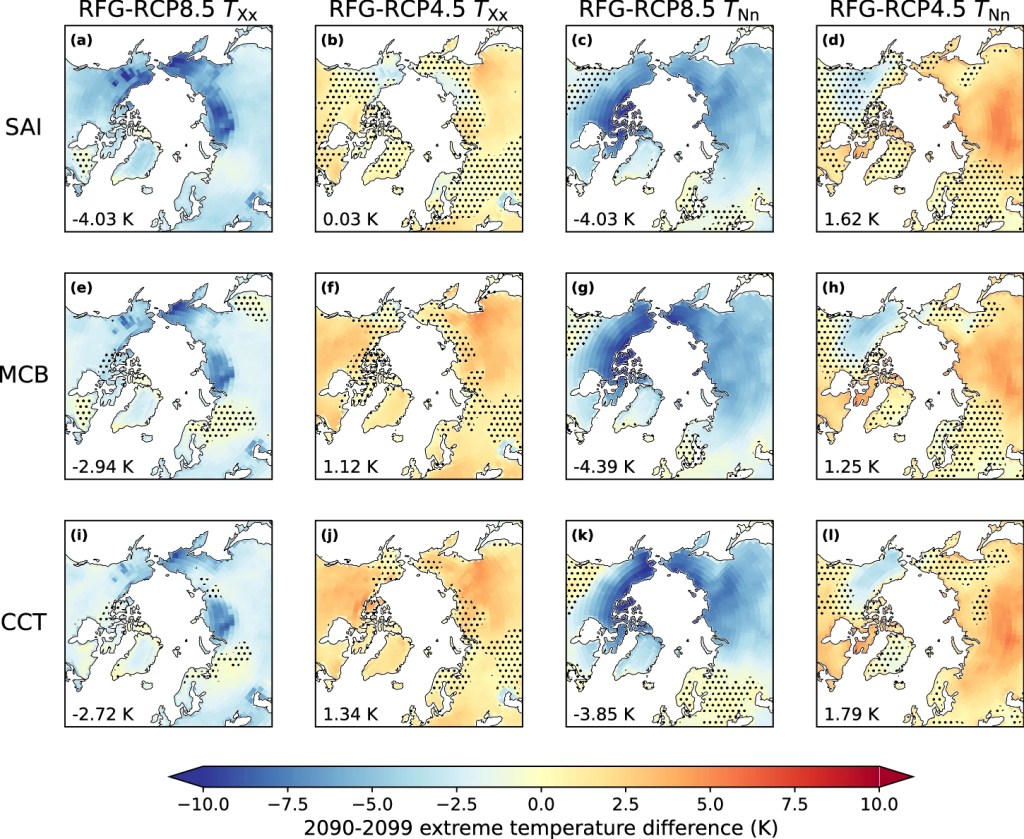
Figure 1 from Lee et al. (2024). Comparison of how Arctic maximum (TXx) and minimum (TNn) temperatures change under three “radiative forcing geoengineering” (RFG) proposals — stratospheric aerosol injection (SAI), marine cloud brightening (MCB), and cirrus cloud thinning (CCT) — as compared to a world with very high greenhouse gas emissions but no RFG (RCP8.5) or a world with less greenhouse gas emissions that has the same global mean temperature as that achieved by the RFGs (RCP4.5). Importantly, the RFGs are applied on a high greenhouse gas background (RCP8.5), meaning the RFG-RCP8.5 differences (first and third column) show the causal effect of the RFGs, which is to cool the Arctic. Comparing the RFGs with RCP4.5 (second and fourth columns) gives an indication of how efficiently or inefficiently the RFG cools the Arctic as compared to decarbonization; in this model, the RFGs generally cool the Arctic less efficiently. However, it would be a conceptual mistake to say that the RFGs warm the Arctic: Their causal effect is clearly cooling, albeit less efficiently than decarbonization. A paper only focusing on the RFG-RCP8.5 differences could therefore oversell the benefits of the RFGs while a paper focusing on the RFG-RCP4.5 differences could mischaracterize the (imperfect) benefit of RFG as a harm due to RFG. For a balanced assessment of climate interventions, it’s necessary to keep both perspectives in mind simultaneously.
Our new Matters Arising paper, “Informative risk analyses of radiative forcing geoengineering require proper counterfactuals”, has been published in Communications Earth & Environment in response to another article that we felt did not properly communicate their results. The root of the disagreement lies in what we consider to be the proper “counterfactual”, or situation that would exist in the absence of the object of study. In this case, Müller and colleagues looked at simulations of different solar climate interventions (radiative forcing geoengineering methods in their terminology) that were designed to cool global temperatures to close to what would occur in a moderate greenhouse gas emission scenario (RCP4.5) despite actually having much higher greenhouse gas emissions (RCP8.5). Because there is residual warming in the Arctic, the authors claimed that RFG increased the risk in the Arctic; we believe this claim is confused and misleading, as the RFGs actually reduced the risk in the Arctic compared to the high emission scenario on which they were applied, just not by as much as if emissions had been reduced as in RCP4.5. Figure 1 from our paper, reproduced above, shows how a paper focusing only on the RFG-RCP8.5 differences may overstate the benefits of RFGs (if there exists any tradeoff between RFGs and decarbonization) whereas one focusing on the RFG-RCP4.5 differences would mischaracterize the imperfect benefits of the RFGs as being a direct harm from implementing the RFGs.
The study “Radiative forcing geoengineering under high CO2 levels leads to higher risk of Arctic wildfires and permafrost thaw than a targeted mitigation scenario” by Müller, et al. examines three scenarios of radiative forcing geoengineering as simulated by the Norwegian Earth System Model. The authors compare high-latitude boreal summer maximum temperatures and winter minimum temperatures in the geoengineering scenarios – stratospheric aerosol injection, marine cloud brightening, and cirrus cloud thinning – to high-warming and moderate-warming scenarios without geoengineering. They conclude that all three geoengineering interventions, which use the high-warming scenario as the baseline, worsen the risk of wildfire and permafrost thaw relative to the moderate-warming scenario because they cool the Arctic somewhat less than the global mean in their experiments. We have significant concerns about how this paper’s results and conclusions are framed.
First and foremost, Müller et al. claim that geoengineering increases the risk of wildfires and permafrost thaw; instead, what the authors show is that geoengineering reduces these risks, but not as much as an equivalent scenario and emissions cuts. We note that the original title, “Radiative forcing geoengineering causes a higher risk of wildfires and permafrost thawing over the Arctic regions”, made this claim more explicit than the revision, which is an improvement. However, both framings of “risk” suffer from the fundamental defect of comparing geoengineering to an inappropriate baseline: the three geoengineering scenarios use RCP8.5 (a high-emissions, high-warming scenario) as the background, but the authors primarily compare the geoengineering scenarios to RCP4.5 (a moderate-warming scenario) instead of the more appropriate counterfactual of higher emissions without geoengineering. Secondly, the authors overgeneralize from a limited set of simulations even though it is now well known that regional impacts are highly dependent on the specific geoengineering strategy employed.
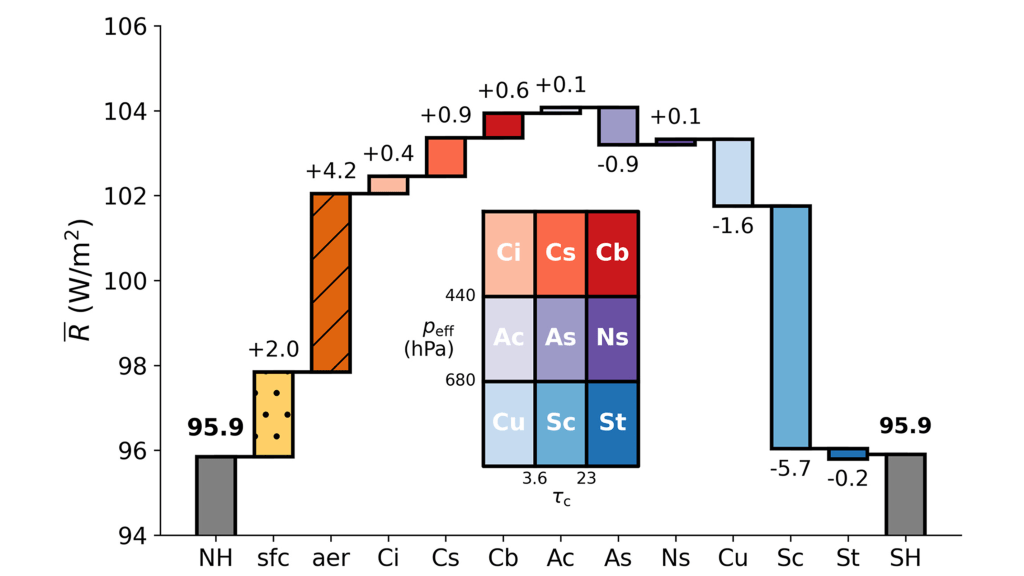
Figure. Waterfall plot showing how much sunlight is reflected (R) by the Northern and Southern Hemispheres (NH and SH) and whether more reflection comes from the surface, aerosols, and different cloud types (see inset) in the NH (positive values) or SH (negative values). We still do not know why these different reflection components balance to give equal NH and SH reflection.
Earth’s Northern and Southern Hemispheres reflect essentially equal amounts of sunlight, but how—and whether—this “hemispheric albedo symmetry” is maintained remains a mystery. Our new paper in Geophysical Research Letters breaks down observations of reflected sunlight into components associated with the surface, clear-sky atmosphere, and different cloud types to test the leading hypotheses for this phenomenon, which include shifts in tropical thunderstorms or changes in the midlatitude storm tracks. For more information, check out our Plain Language summary below or read the open-access article at: https://agupubs.onlinelibrary.wiley.com/doi/full/10.1029/2024GL111733.
Mysteriously, the Northern and Southern Hemispheres reflect the same amount of sunlight as each other, but scientists are not yet sure why, how, or even whether this phenomenon is sustained by the Earth system. The Northern Hemisphere is brighter in clear skies because it contains more pollution particles in the atmosphere and has more land area, whereas the Southern Hemisphere is cloudier. We break down this cloudiness contrast into components related to different cloud types defined by their height and thickness. Tropical high-altitude clouds increase reflection preferentially in the Northern Hemisphere but are overcompensated by low- and mid-level clouds in the Southern Hemisphere, especially in the subtropics and midlatitudes. Both hemispheres have darkened over the past two decades, but whether the Northern Hemisphere is darkening faster than the Southern Hemisphere due to decreasing particulate pollution or if they are darkening at the exact same rate remains uncertain. Based on long-term trends and “natural experiments” like sea ice loss and volcanic eruptions, we can rule out the hypothesis that low-level clouds in the Southern Ocean act to balance out clear-sky asymmetries at yearly-to-decadal timescales, but we cannot rule out the hypothesis that high-altitude tropical clouds do so.
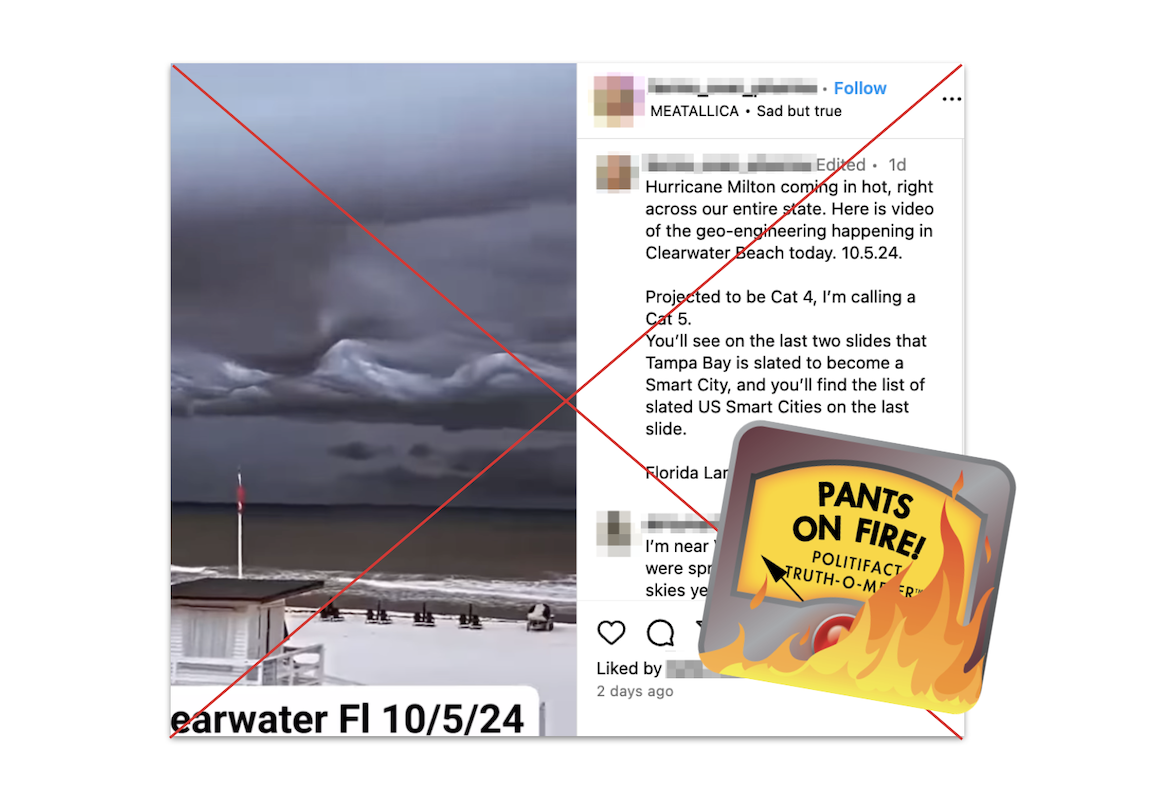
Politifact Truth-O-Meter rating for the idea that the pictured clouds are related to artificial hurricanes: Pants on fire!
Michael spoke with Politifact the day before Hurricane Milton made landfall in Florida to help debunk social media conspiracy theories that pictures of unusual and visually striking cloud patterns are evidence that the government is “geoengineering” hurricanes. You can read some of the highlights below, or check out the full fact check at Politifact.
Michael Diamond, Florida State University assistant professor of meteorology, and Erik Nielsen, instructional assistant professor at Texas A&M University’s Department of Atmospheric Sciences, identified these clouds as asperitas — rare clouds that “resemble rippling ocean waves in the sky.”
There is no established explanation why these clouds form, according to the U.K. Met Office, but “atmospheric conditions must be unstable.” They don’t produce rainfall but typically appear after thunderstorms, the office said.
“(Asperitas) clouds are associated with thunderstorms but don’t produce storms themselves,” Diamond said. “These clouds cannot be formed through geoengineering or cloud seeding, to our present knowledge.”
Diamond also pointed out that Hurricane Milton was still far from the coast when these claims were made.
This video doesn’t show geoengineering occurring as Hurricane Milton approaches Florida. We rate that Pants on Fire!