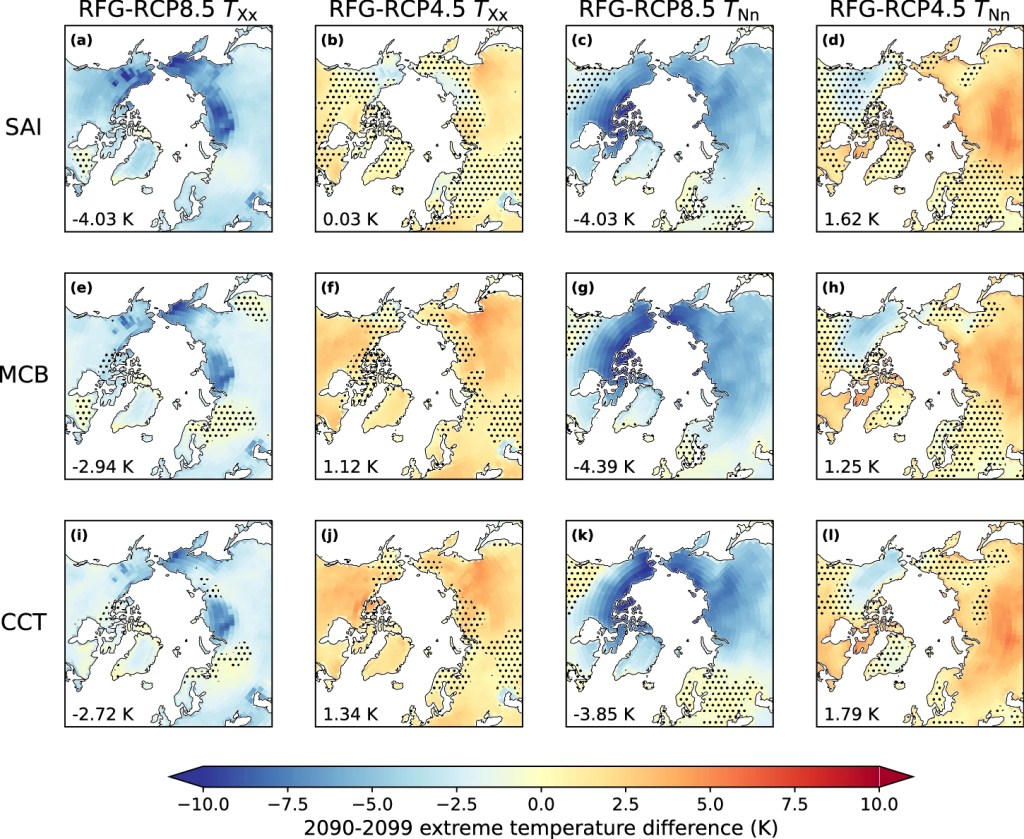
Our new Matters Arising paper, “Informative risk analyses of radiative forcing geoengineering require proper counterfactuals”, has been published in Communications Earth & Environment in response to another article that we felt did not properly communicate their results. The root of the disagreement lies in what we consider to be the proper “counterfactual”, or situation that would exist in the absence of the object of study. In this case, Müller and colleagues looked at simulations of different solar climate interventions (radiative forcing geoengineering methods in their terminology) that were designed to cool global temperatures to close to what would occur in a moderate greenhouse gas emission scenario (RCP4.5) despite actually having much higher greenhouse gas emissions (RCP8.5). Because there is residual warming in the Arctic, the authors claimed that RFG increased the risk in the Arctic; we believe this claim is confused and misleading, as the RFGs actually reduced the risk in the Arctic compared to the high emission scenario on which they were applied, just not by as much as if emissions had been reduced as in RCP4.5. Figure 1 from our paper, reproduced above, shows how a paper focusing only on the RFG-RCP8.5 differences may overstate the benefits of RFGs (if there exists any tradeoff between RFGs and decarbonization) whereas one focusing on the RFG-RCP4.5 differences would mischaracterize the imperfect benefits of the RFGs as being a direct harm from implementing the RFGs.
To read more, the introduction of our paper is provided below and the open-access full text is available at: https://www.nature.com/articles/s43247-024-01881-y.
The study “Radiative forcing geoengineering under high CO2 levels leads to higher risk of Arctic wildfires and permafrost thaw than a targeted mitigation scenario” by Müller, et al. examines three scenarios of radiative forcing geoengineering as simulated by the Norwegian Earth System Model. The authors compare high-latitude boreal summer maximum temperatures and winter minimum temperatures in the geoengineering scenarios – stratospheric aerosol injection, marine cloud brightening, and cirrus cloud thinning – to high-warming and moderate-warming scenarios without geoengineering. They conclude that all three geoengineering interventions, which use the high-warming scenario as the baseline, worsen the risk of wildfire and permafrost thaw relative to the moderate-warming scenario because they cool the Arctic somewhat less than the global mean in their experiments. We have significant concerns about how this paper’s results and conclusions are framed.
First and foremost, Müller et al. claim that geoengineering increases the risk of wildfires and permafrost thaw; instead, what the authors show is that geoengineering reduces these risks, but not as much as an equivalent scenario and emissions cuts. We note that the original title, “Radiative forcing geoengineering causes a higher risk of wildfires and permafrost thawing over the Arctic regions”, made this claim more explicit than the revision, which is an improvement. However, both framings of “risk” suffer from the fundamental defect of comparing geoengineering to an inappropriate baseline: the three geoengineering scenarios use RCP8.5 (a high-emissions, high-warming scenario) as the background, but the authors primarily compare the geoengineering scenarios to RCP4.5 (a moderate-warming scenario) instead of the more appropriate counterfactual of higher emissions without geoengineering. Secondly, the authors overgeneralize from a limited set of simulations even though it is now well known that regional impacts are highly dependent on the specific geoengineering strategy employed.
Lee et al. (2024), Communications Earth & Environment, doi:10.1038/s43247-024-01881-y

