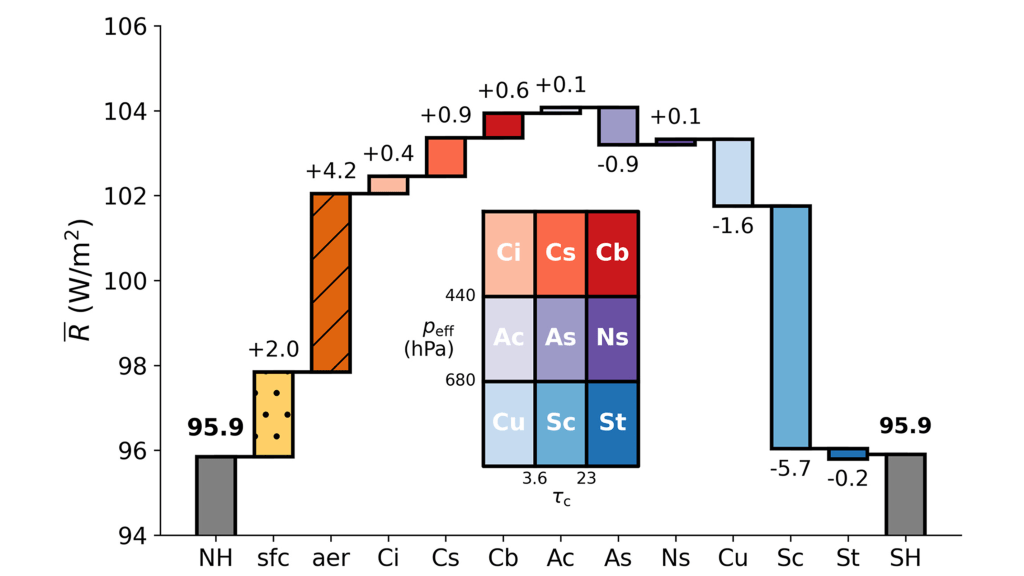
Earth’s Northern and Southern Hemispheres reflect essentially equal amounts of sunlight, but how—and whether—this “hemispheric albedo symmetry” is maintained remains a mystery. Our new paper in Geophysical Research Letters breaks down observations of reflected sunlight into components associated with the surface, clear-sky atmosphere, and different cloud types to test the leading hypotheses for this phenomenon, which include shifts in tropical thunderstorms or changes in the midlatitude storm tracks. For more information, check out our Plain Language summary below or read the open-access article at: https://agupubs.onlinelibrary.wiley.com/doi/full/10.1029/2024GL111733.
Mysteriously, the Northern and Southern Hemispheres reflect the same amount of sunlight as each other, but scientists are not yet sure why, how, or even whether this phenomenon is sustained by the Earth system. The Northern Hemisphere is brighter in clear skies because it contains more pollution particles in the atmosphere and has more land area, whereas the Southern Hemisphere is cloudier. We break down this cloudiness contrast into components related to different cloud types defined by their height and thickness. Tropical high-altitude clouds increase reflection preferentially in the Northern Hemisphere but are overcompensated by low- and mid-level clouds in the Southern Hemisphere, especially in the subtropics and midlatitudes. Both hemispheres have darkened over the past two decades, but whether the Northern Hemisphere is darkening faster than the Southern Hemisphere due to decreasing particulate pollution or if they are darkening at the exact same rate remains uncertain. Based on long-term trends and “natural experiments” like sea ice loss and volcanic eruptions, we can rule out the hypothesis that low-level clouds in the Southern Ocean act to balance out clear-sky asymmetries at yearly-to-decadal timescales, but we cannot rule out the hypothesis that high-altitude tropical clouds do so.
Plain Language Summary


One thought on “Paper testing hypotheses for how clouds might balance sunlight between Earth’s hemispheres published in GRL”