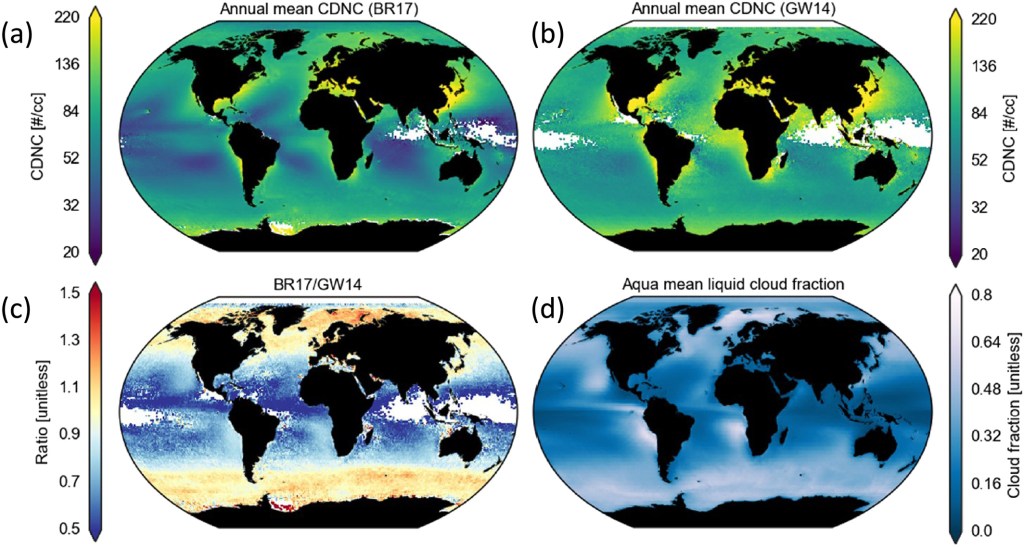
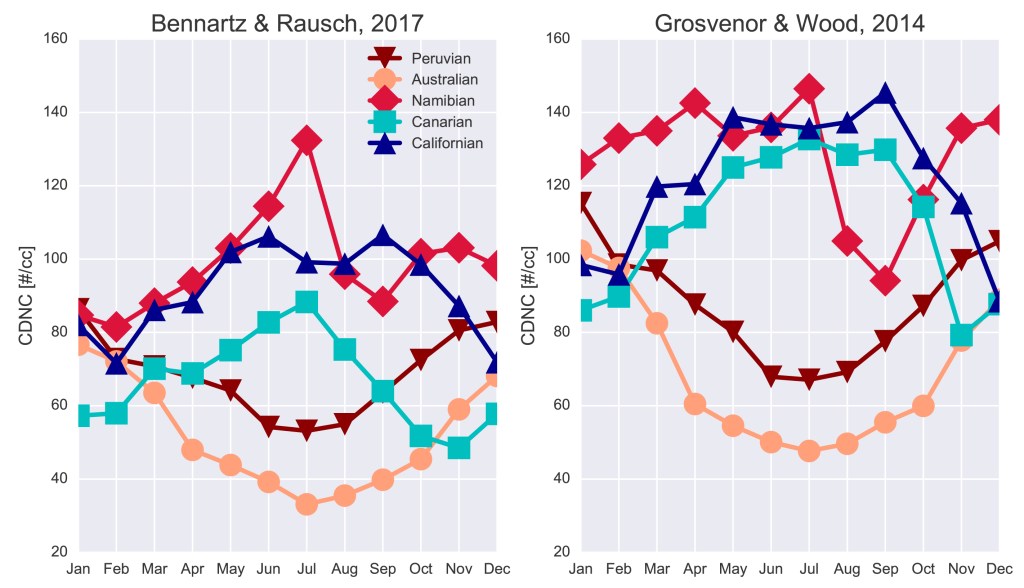
Uncertainty about the interactions between tiny airborne particles (aerosols) and clouds is one of the biggest challenges in quantifying how much human activities have perturbed Earth’s energy balance since the Industrial Revolution. These interactions are primarily mediated by changes in the cloud droplet number concentration (CDNC), or how many cloud droplets there are in a given cubic centimeter of cloudy air. Unfortunately, we cannot directly retrieve CDNC with satellite instruments. We can, however, use our knowledge of cloud physics to estimate CDNC using other cloud properties that can be retrieved directly. I am interested in using observations to help validate and improve these estimates.
For more information, check out our (open-access!) paper in Reviews of Geophysics:
Grosvenor, Daniel, O. Sourdeval, P. Zuidema, A. Ackerman, M. Alexandrov, R. Bennartz, R. Boers, B. Cairns, J. Chiu, M. Christensen, H. Deneke, M. Diamond, G. Feingold, A. Fridlind, A. Hünerbein, C. Knist, P. Kollias, A. Marshak, D. McCoy, D. Merk, D. Painemal, J. Rausch, D. Rosenfeld, H. Russchenberg, P. Seifert, K. Sinclair, P. Stier, B. van Diedenhoven, M. Wendisch, F. Werner, R. Wood, Z. Zhang, & J. Quaas (2018). Remote sensing of droplet number concentration in warm clouds: A review of the current state of knowledge and perspectives. Reviews of Geophysics, 56, 409-453, doi:10.1029/2017RG000593

