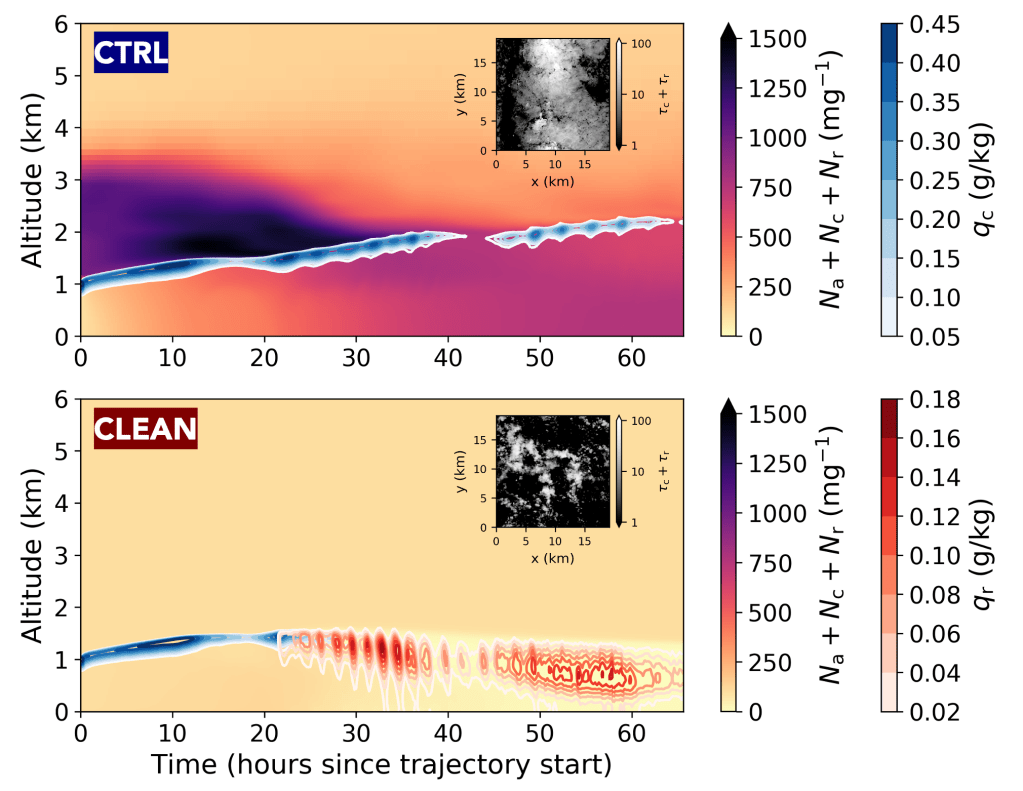
The transition between overcast stratocumulus clouds near the western coasts of North and South America and southern Africa to broken trade cumulus clouds offshore has been a longstanding interest of the cloud physics community. The speed of this stratocumulus-to-cumulus transition (SCT) is important for Earth’s climate because the overcast stratocumulus clouds reflect much more sunlight back to space than do the scattered cumuli.
Our traditional understanding of the SCT is that it’s fundamentally driven by clouds mixing in dry air as they deepen when moving over warmer sea surface temperatures (“deepening-warming” transition), with precipitation playing a relatively minor role. However, advances in representing aerosol-cloud-precipitation interactions in cloud-resolving models have led to the discovery of another, more rapid pathway driven by a positive feedback between rain formation and aerosol depletion (“drizzle-depletion” transition). My group is currently coordinating an international model intercomparison project to better understand under what conditions each type of transition occurs.

