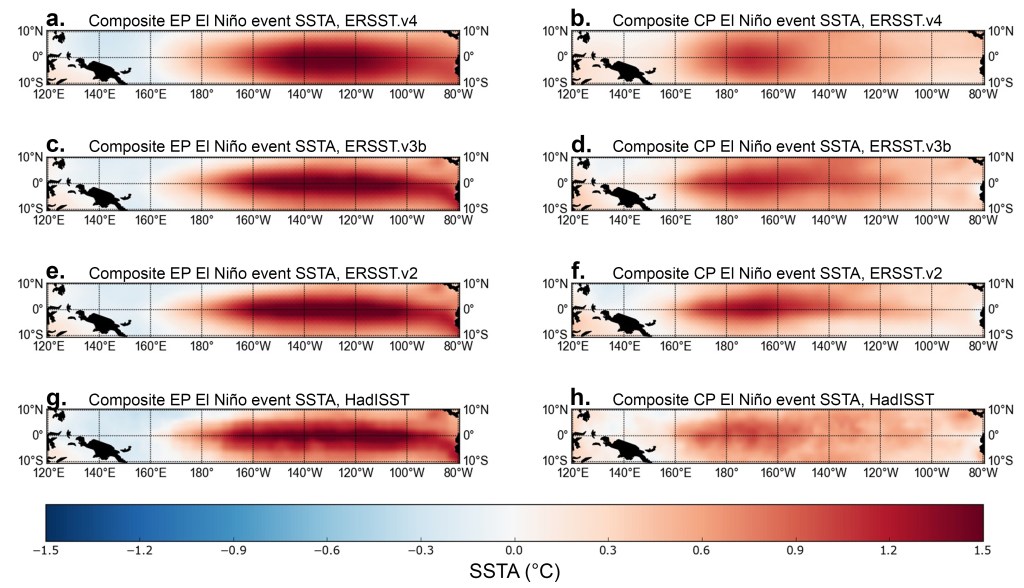
The El Niño-Southern Oscillation, in which hot and cold sea surface temperature anomalies oscillate between the Western and Central/Eastern Pacific Ocean, is the main source of year-to-year variability in Earth’s climate. Different studies have argued that there are two distinct types of El Niño, one that peaks in the Central Pacific (CP El Niño) and one that peaks in the Eastern Pacific (EP El Niño) off the coast of Peru. Our work shows that the methods used to classify El Niño events into these types are highly dependent on the version of the sea surface temperature dataset being used, calling into question the robustness of previous findings that associate different weather anomalies outside the tropics (like rainfall in California) with the different types of El Niño.
For more information, check out our paper in GRL (it’s open access!):
Diamond, Michael, & R. Bennartz (2015). Occurrence and trends of eastern and central Pacific El Niño in different reconstructed SST data sets. Geophysical Research Letters, 42(23), 10,375-10,381, doi:10.1002/2015gl066469

