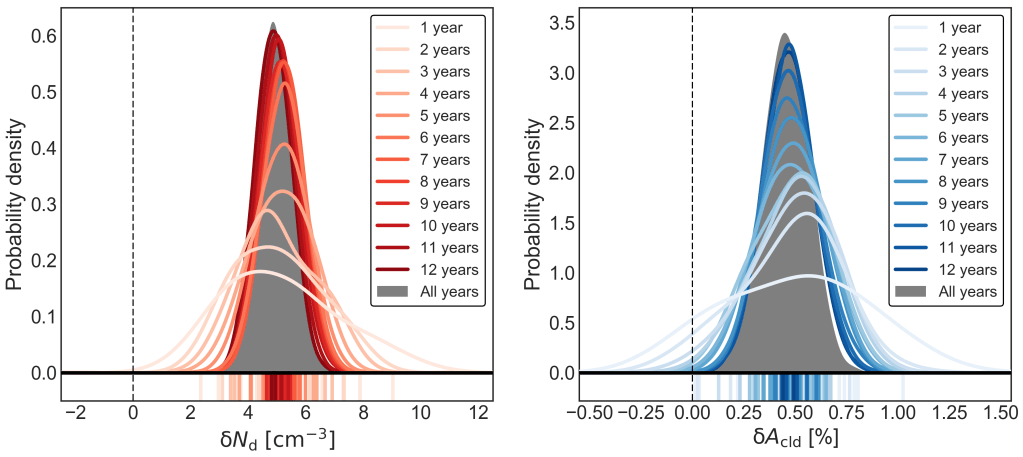
We care about air pollution not only because of its harmful effects on human health, but also because tiny airborne particles of pollution known as aerosols can affect the climate. Aerosol particles themselves can affect temperatures by absorbing light (think of the eerie orange skies produced by smoke over Seattle in recent summers) and scattering it (reflecting it away — think of how much visibility declines on hazy, high pollution days). Aerosol particles can also affect the climate indirectly through their interactions with clouds.
Clouds are made up of tiny droplets of water, each of which must be “seeded” by an aerosol particle. When the number of aerosol particles increases, a cloud’s water can be spread out over a larger number of small droplets instead of a small number of big droplets. This ends up increasing the reflectivity, or brightness, of the cloud.
Ship tracks, or curvilinear trails of brightened clouds following individual ships, is the quintessential example of these aerosol-cloud interactions in action. Mysteriously, however, past attempts to measure the effects of ship tracks over long time periods and large regions have failed to find substantial effects, despite climate models predicting sizable cooling effects from brighter clouds reflecting more sunlight. This is in part due to how much variation occurs in the clouds naturally, making the signal of the aerosol effects very difficult to detect.

In our study, we took advantage of a unique meteorological situation in the southeast Atlantic (see Figure 2) in which the prevailing winds keep pollution relatively constrained around a major shipping corridor that passes through one of the cloudiest regions on Earth. By analyzing the statistics of cloud properties of nearby, unaffected regions, we predicted what cloud properties would have been in the shipping corridor in the absence of shipping pollution. We then estimated the effect of the shipping pollution by comparing that prediction to what we actually see in the satellite data. Our study is the first to observe a significant cooling effect due to cloud brightening over climate-relevant temporal and spatial scales.
Even before their large-scale effects were confirmed, some scientists have suggested that clouds over the oceans could be deliberately seeded with sea salt particles to produce a cooling effect that would help counteract some of the warming we have experienced due to rising greenhouse gas concentrations in the atmosphere. This proposal, called marine cloud brightening, still requires a lot of research before it could be implemented — or before we decide if it would ever be a good idea to implement it in the first place. Our study contributes to answering two of the open questions about potential field tests of marine cloud brightening: Would they work? And if so, how long would they be required to go on for to see an effect?
As for the first question, our results are fairly positive for proponents of marine cloud brightening: If ships are already inadvertently producing large cooling effects in certain regions, it seems very likely that we could replicate and even enhance these effects deliberately.
On the question of detectability, however, our results are somewhat less optimistic for marine cloud brightening’s prospects. Even in the ideal conditions of the southeast Atlantic, it takes ~5 years of data before the shipping signal of increasing cloud brightness becomes clear (see Figure 1 at the top of this post). Of course, if the test were to aim for a larger effect, it would be more detectable. There will be a real tradeoff in terms of having a light touch with the size of the intervention or the length of time we have to intervene before we can observe how successful the test was.
Below, I summarize what our new study does, and, importantly, does not, teach us about the prospect of deliberate marine cloud brightening.
What the study does tell us about deliberate marine cloud brightening
- A well-designed test will likely be able to produce a significant cloud brightening effect
- In the southeast Atlantic, shipping pollution produces a statistically significant, ~2 W/m2 cooling effect during the spring
- A test may need to be carried out for a substantial period of time to be observable from space
- In the southeast Atlantic, it took ~5 years of springtime data to clearly detect the size of the cloud brightening effect in satellite observations
What the study does not tell us about deliberate marine cloud brightening
- Under what conditions should we consider deploying marine cloud brightening?
- Even if tests of marine cloud brightening are successful (in terms of producing the desired cooling effect), there would be many ethical, socioeconomic, and political questions to answer before it could/should be implemented
- For instance, if it appeared that a limited deployment of marine cloud brightening could limit warming to 1.5 °C (2.7 °F) instead of 2 °C (3.6 °F), would it be worth the risk?
- We will need physical scientists, social scientists, those in the humanities, and voices from impacted communities and citizen input to be able to answer a question like this
- Would it be technologically feasible to produce aerosol particles that are not harmful to human health?
- The sulfate particles produced by shipping pollution contribute to air pollution that sickens and even kills thousands of people per year
- Researchers are still actively working on designing nozzles to produce salt particles of the right size to produce a strong cooling effect
- What kind of unintended consequences could result from marine cloud brightening?
- Because the cloud conditions that are most promising for marine cloud brightening only occur in certain regions, it is possible that causing large, non-uniform changes could perturb weather patterns elsewhere
- How would testing or implementation of marine cloud brightening be governed?
- In the United States, the National Oceanic and Atmospheric Administration (NOAA) is the agency with the relevant jurisdiction
- The Weather Modification Reporting Act of 1972 gives NOAA the responsibility to oversee any research related to weather modification and the Atmospheric Climate Intervention Research Act introduced in the 2019-2020 Congressional session would further clarify NOAA’s role in conducting research into possible climate interventions
- The National Academies of Sciences, Engineering, and Medicine is currently working on a report focusing on the highest-priority research avenues and how they should be governed (including the need for public participation)
- International governance of climate interventions is still an active topic of scholarly debate
- In the United States, the National Oceanic and Atmospheric Administration (NOAA) is the agency with the relevant jurisdiction


One thought on “What can inadvertent cloud changes due to shipping pollution in the southeast Atlantic teach us about deliberate climate interventions?”