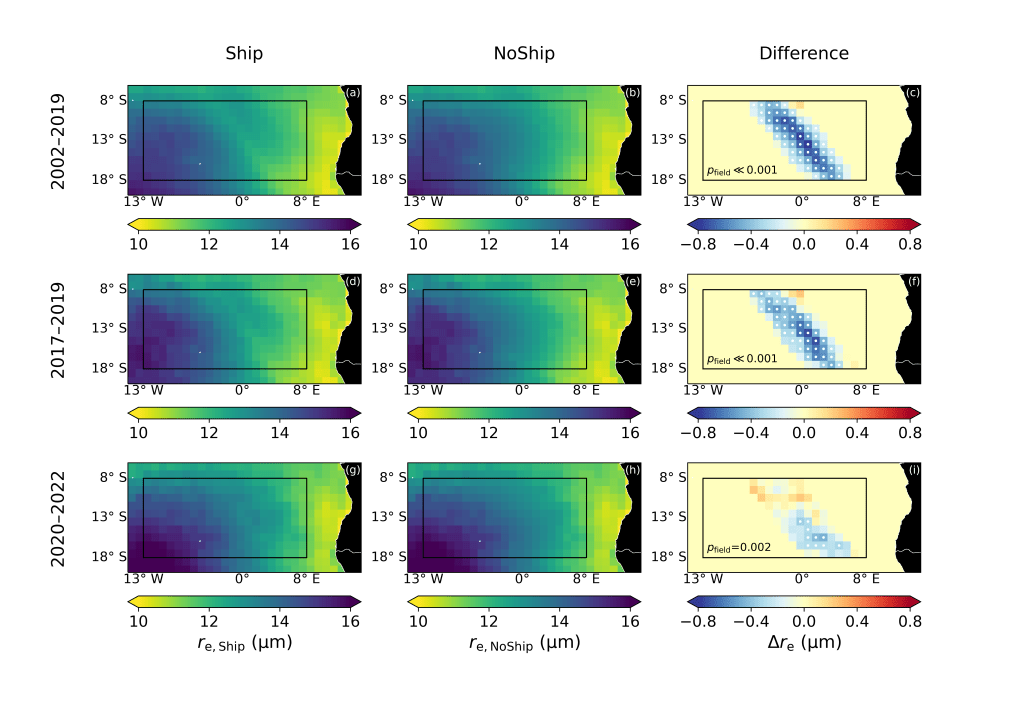
New regulations from the International Maritime Organization (IMO) limiting sulfur emissions from the shipping industry are expected to have large benefits in terms of public health but come with an undesired side effect: a possible acceleration of global warming as the climate-cooling effects of ship pollution on marine clouds is diminished. Although previous work has found a substantial decrease in the detection of ship tracks (curvilinear cloud perturbations following individual ship smokestacks) after the IMO 2020 regulations went into effect, changes in large-scale cloud properties have been more equivocal. Using a statistical technique that estimates counterfactual fields of what large-scale cloud and radiative properties within an isolated shipping corridor in the southeastern Atlantic would have been in the absence of shipping, we confidently detect a reduction in the magnitude of cloud droplet effective radius decreases (see Figure above) within the shipping corridor and find evidence for a reduction in the magnitude of cloud brightening as well. These changes lead to a non-negligible heating effect within the shipping corridor and lend credence to estimates of a sizable warming effect globally. Our results also provide independent evidence for general compliance with the IMO 2020 regulations.
To read more, the (not-yet-peer-reviewed!) pre-print is publicly available at: https://egusphere.copernicus.org/preprints/2023/egusphere-2023-971/

