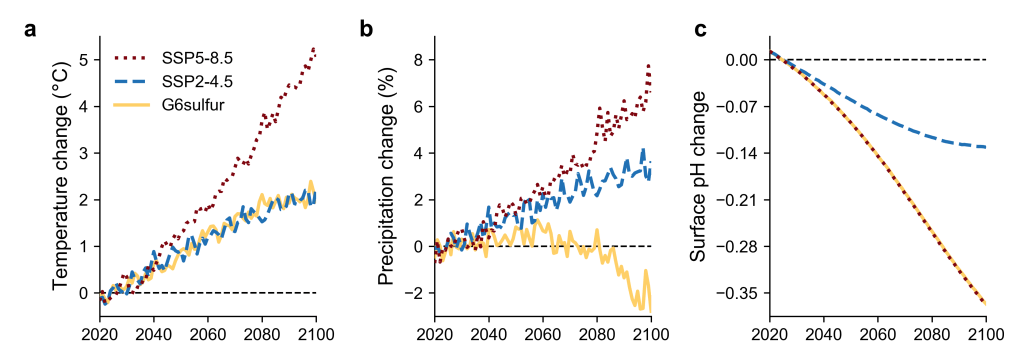
Despite substantial progress in clean technology and increasing policy ambition, the world remains off track to hold warming to the Paris Agreement targets of well below 2 °C and no greater than 1.5 °C above pre-industrial temperatures. In light of this, a growing number of scientists and advocates have called for expanding research into solar climate interventions that would utilize tiny solid or liquid particles suspended in the atmosphere (aerosols) to reflect more sunlight away from Earth and thus offset some of the effects of global warming due to greenhouse gas emissions from fossil fuel burning and deforestation.
Notwithstanding the relatively early state of solar climate intervention research, at least one company has already been founded to market “cooling credits” that purport to offset a given quantity of greenhouse gas emissions with the emission of aerosols or their precursor gases. In the near-term, the science of solar climate intervention is simply too uncertain for such credits to be meaningful market instruments. More fundamentally, however, many of the climatic and environmental effects of greenhouse gas emissions are incommensurate with those from aerosol injections. If solar climate interventions are to be part of society’s portfolio of responses to climate change, they must be complements to, not substitutes for, mitigation. A market approach to solar climate intervention based on “cooling credits” is not a viable climate solution.
To learn more about the reasoning behind this assessment, please check out our (open-access!) paper in Climatic Change or Kelly Wanser’s plain-language post in Illuminem.

