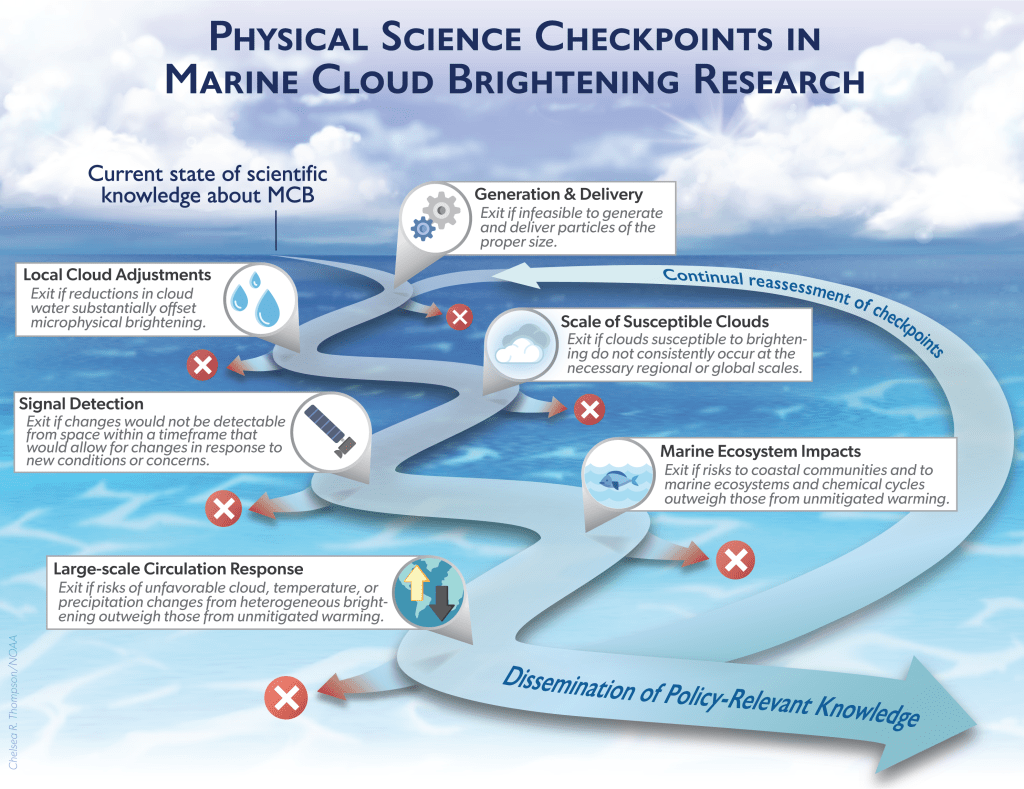
Our paper laying out “checkpoints” and “exit ramps” for marine cloud brightening (MCB) research was just published in the Proceedings of the National Academy of Sciences of the United States of America. We lay out a framework for what researchers need to study to assess the technical feasibility of MCB — and when we should stop if MCB turns out to be technically or socially unviable.
MCB is a proposal to seed marine clouds with salt particles so they reflect more sunlight, producing a cooling effect. Although there is a consensus that decarbonizing the economy is the most important step to limit the damage of climate change, solar climate interventions like MCB have been proposed as a way to temporarily offset some of the effects of global warming and buy the world more time to reduce greenhouse gas emissions.
The paper is publicly available at: https://www.pnas.org/content/119/4/e2118379119
For more information, you can also check out our NOAA Research web story and my interview on the Reviewer 2 Does Geoengineering podcast.

