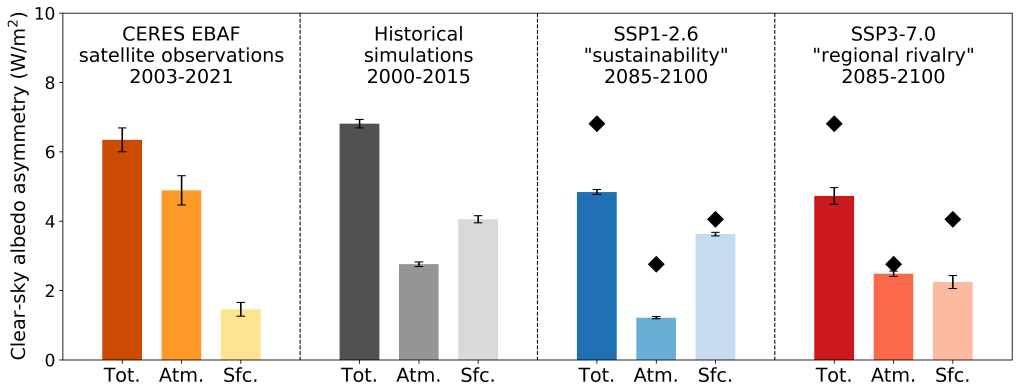
A striking and mysterious feature of the Earth system is that the Northern and Southern Hemispheres reflect identical amounts of sunlight. This hemispheric albedo symmetry comprises two asymmetries: The Northern Hemisphere is more reflective in clear skies, whereas the Southern Hemisphere is cloudier. The clear-sky asymmetry has surface and atmospheric components, with the relatively-bright continents and aerosol (airborne particulate matter) both disproportionately located in the Northern Hemisphere.
In our new (open-access) paper, we show that the continent-based component of the clear-sky surface asymmetry is largely offset by greater reflection from the Antarctic surface than the Arctic surface, allowing the net clear-sky asymmetry to be dominated by atmospheric aerosol. Climate model simulations suggest that anthropogenic aerosol emissions since the pre-industrial era have driven a large increase in the clear-sky asymmetry that would reverse in future low-emission scenarios featuring rapid decarbonization and decreases in co-emitted aerosol. High-emission scenarios also show a decrease in asymmetry, but instead driven by declines in Northern Hemisphere ice and snow cover. Strong clear-sky hemispheric albedo asymmetry is therefore a transient, rather than fixed, feature of Earth’s climate. If all-sky symmetry is maintained despite changes in the clear-sky asymmetry, compensating cloud changes would have uncertain but important implications for Earth’s energy balance and hydrological cycle.
For more information, please check out the paper or my “Behind the Paper” blog post in the Nature Portfolio Earth and Environment Community.

