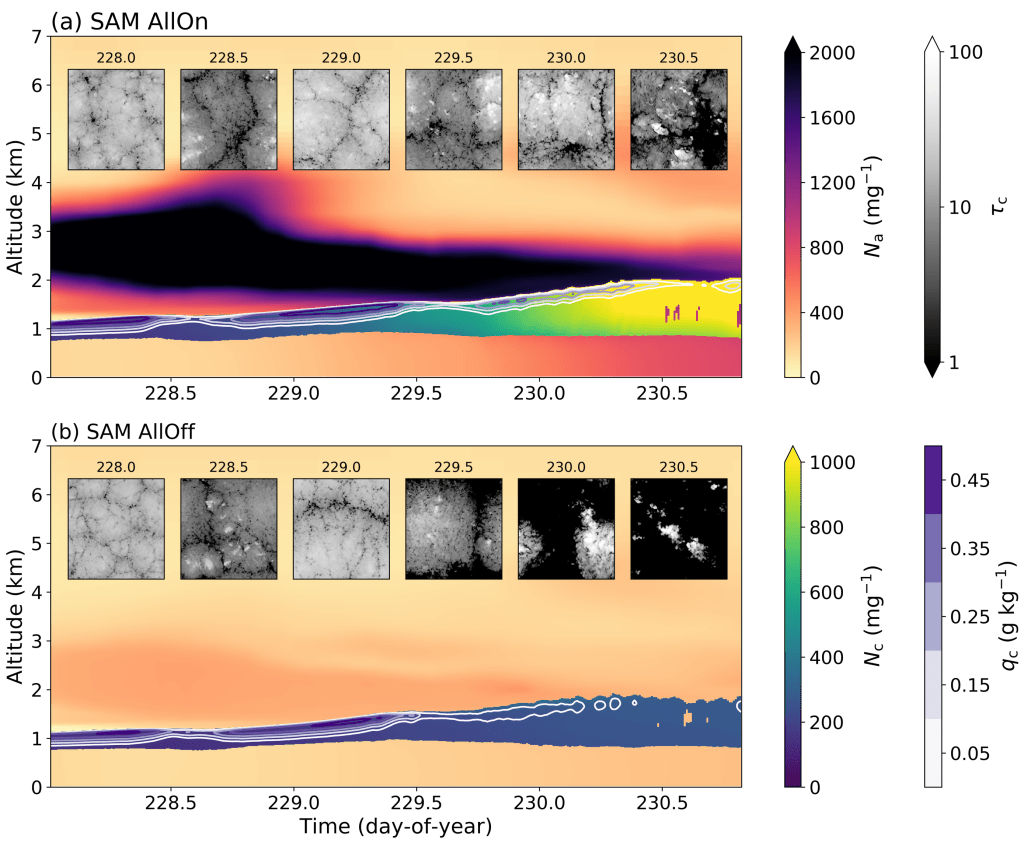
Smoke from southern Africa blankets the southeast Atlantic Ocean from June-October, overlying a major low-altitude cloud deck. The smoke affects Earth’s radiation budget by absorbing and reflecting radiation directly and by changing cloud properties via their effect on atmospheric temperature and circulation and by seeding additional cloud droplets when they get mixed into the marine boundary layer. Each of these aerosol radiative effects can be large in magnitude but often have offsetting cooling and warming influences.
In our new (open-access!) paper, we investigate smoke effects on the transition between overcast stratocumulus and scattered cumulus clouds along a Lagrangian (air-mass-following) trajectory in regional climate and large eddy simulation (LES) models. We also compare our results with observations from three recent field campaigns that took place in August 2017: ORACLES (NASA), CLARIFY (UK Met Office), and LASIC (US Department of Energy). The case study is set up around a joint ORACLES-CLARIFY flight that took place near Ascension Island on 18 August 2017. Smoke sampled upstream on an ORACLES flight on 15 August 2017 likely entrained into the marine boundary layer later sampled during the joint flight.
The regional climate model is run three times, once including all smoke effects, once excluding smoke entirely, and once with smoke radiative effects turned off. We find that in addition to the expected result of smoke absorption of sunlight increasing temperature in the smoke plume, most of the heating goes toward producing a large decrease in large-scale subsidence over the ocean. When these different smoke effects are used to force an LES that can directly resolve cloud motions, we find that this subsidence effect is more important for cloud evolution than the effect of smoke particles serving as cloud condensation nuclei. Such large-scale “semi-direct” effects of smoke absorption would not have been possible to simulate using a small domain LES model alone.

