Paper reporting the detection of large-scale cloud microphysical changes due to the IMO 2020 fuel sulfur regulations published as an ACP Letter

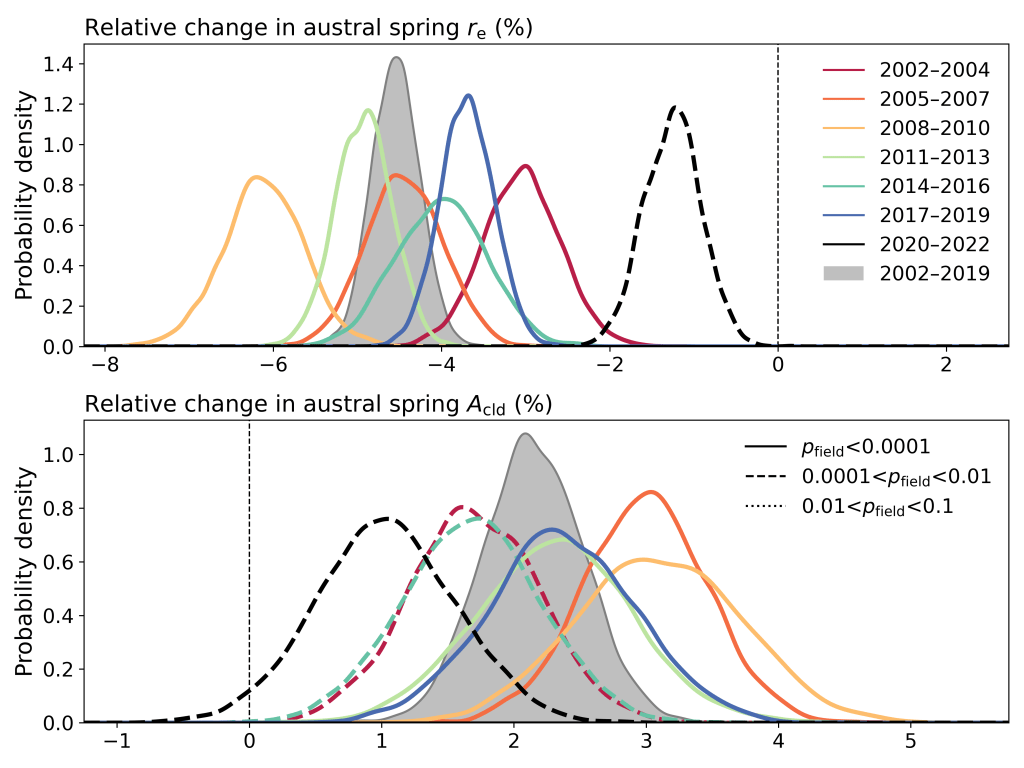
Figure. Substantial decreases in cloud droplet size (top) and increases in cloud brightness (bottom) were caused by pollution from a shipping corridor in the southeast Atlantic Ocean (gray shading for 2002-2019, colors for individual 3-year periods). After new fuel sulfur regulations went into effect in 2020, however, the shipping effects were greatly diminished (black lines).

New regulations from the International Maritime Organization (IMO) limiting sulfur emissions from the shipping industry are expected to have large benefits in terms of public health but may come with an undesired side effect: acceleration of global warming as the climate-cooling effects of ship pollution on marine clouds are diminished. Previous work has found a substantial decrease in the detection of ship tracks in clouds after the IMO 2020 regulations went into effect, but changes in large-scale cloud properties have been more equivocal. Using a statistical technique that estimates counterfactual fields of what large-scale cloud and radiative properties within an isolated shipping corridor in the southeastern Atlantic would have been in the absence of shipping, we confidently detect a reduction in the magnitude of cloud droplet effective radius decreases within the shipping corridor and find evidence for a reduction in the magnitude of cloud brightening as well. The instantaneous radiative forcing due to aerosol–cloud interactions from the IMO 2020 regulations is estimated as O(1 W m−2) within the shipping corridor, lending credence to global estimates of O(0.1 W m−2). In addition to their geophysical significance, our results also provide independent evidence for general compliance with the IMO 2020 regulations.

To learn more, you can find the (open-access!) paper in Atmospheric Chemistry and Physics.
Michael speaks at National Academies panel on climate intervention research in an Earth Systems Science framework

Thanks to the organizers of the National Academies’ Climate Intervention in an Earth Systems Science Framework workshop for inviting me to present as part of their first panel on Cross Cutting Issues, Needs and Opportunities.

Pre-print on how IMO 2020 sulfur regulations have changed cloud properties now available in EGUsphere

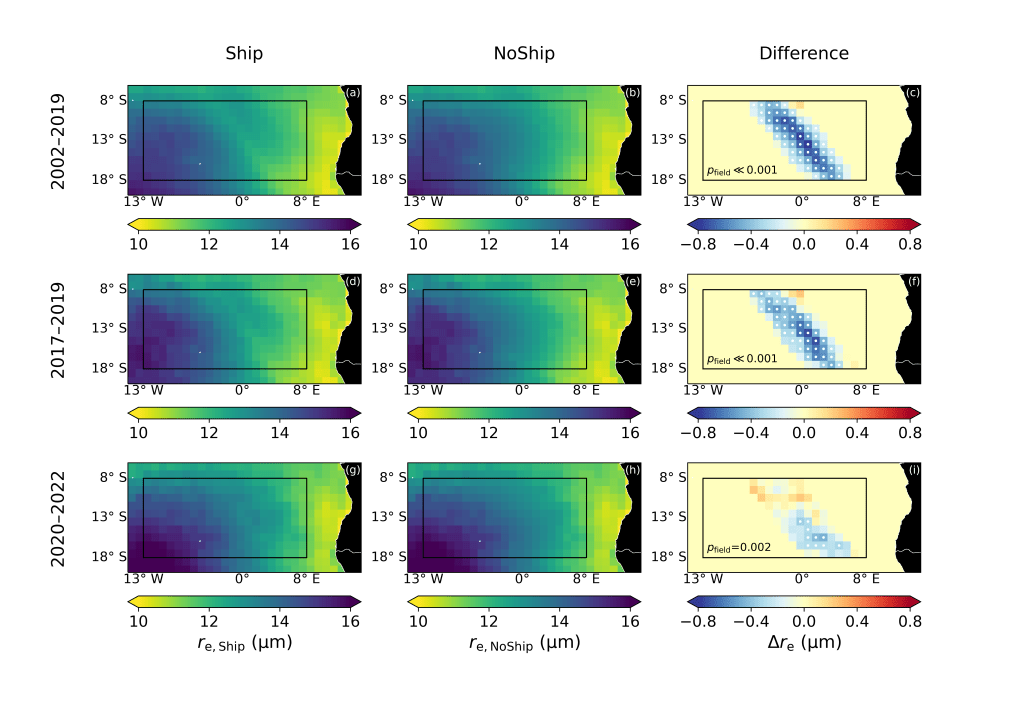
Figure. Observed values (Ship), counterfactual field without the shipping corridor (NoShip), and their difference for cloud droplet effective radius showing substantial decreases in cloud droplet size before the IMO 2020 regulations (top two rows) and much weaker decreases after (bottom row) due to a decrease in ships’ pollution.

New regulations from the International Maritime Organization (IMO) limiting sulfur emissions from the shipping industry are expected to have large benefits in terms of public health but come with an undesired side effect: a possible acceleration of global warming as the climate-cooling effects of ship pollution on marine clouds is diminished. Although previous work has found a substantial decrease in the detection of ship tracks (curvilinear cloud perturbations following individual ship smokestacks) after the IMO 2020 regulations went into effect, changes in large-scale cloud properties have been more equivocal. Using a statistical technique that estimates counterfactual fields of what large-scale cloud and radiative properties within an isolated shipping corridor in the southeastern Atlantic would have been in the absence of shipping, we confidently detect a reduction in the magnitude of cloud droplet effective radius decreases (see Figure above) within the shipping corridor and find evidence for a reduction in the magnitude of cloud brightening as well. These changes lead to a non-negligible heating effect within the shipping corridor and lend credence to estimates of a sizable warming effect globally. Our results also provide independent evidence for general compliance with the IMO 2020 regulations.

To read more, the (not-yet-peer-reviewed!) pre-print is publicly available at: https://egusphere.copernicus.org/preprints/2023/egusphere-2023-971/

Michael gives AGU Early Career Seminar on studying inadvertent and deliberate aerosol perturbations to Earth’s climate

Thanks to the organizers of the AGU Atmospheric Sciences Early Career Seminar Subcommittee for inviting me to speak about my recent work addressing how ship tracks affect Earth’s climate and what we still need to learn to determine if marine cloud brightening via “salt tracks” would be a feasible way to lessen some impacts of climate change. The full video is publicly available on Youtube.

Paper on how smoke affects marine cloud transitions published in Atmospheric Chemistry and Physics

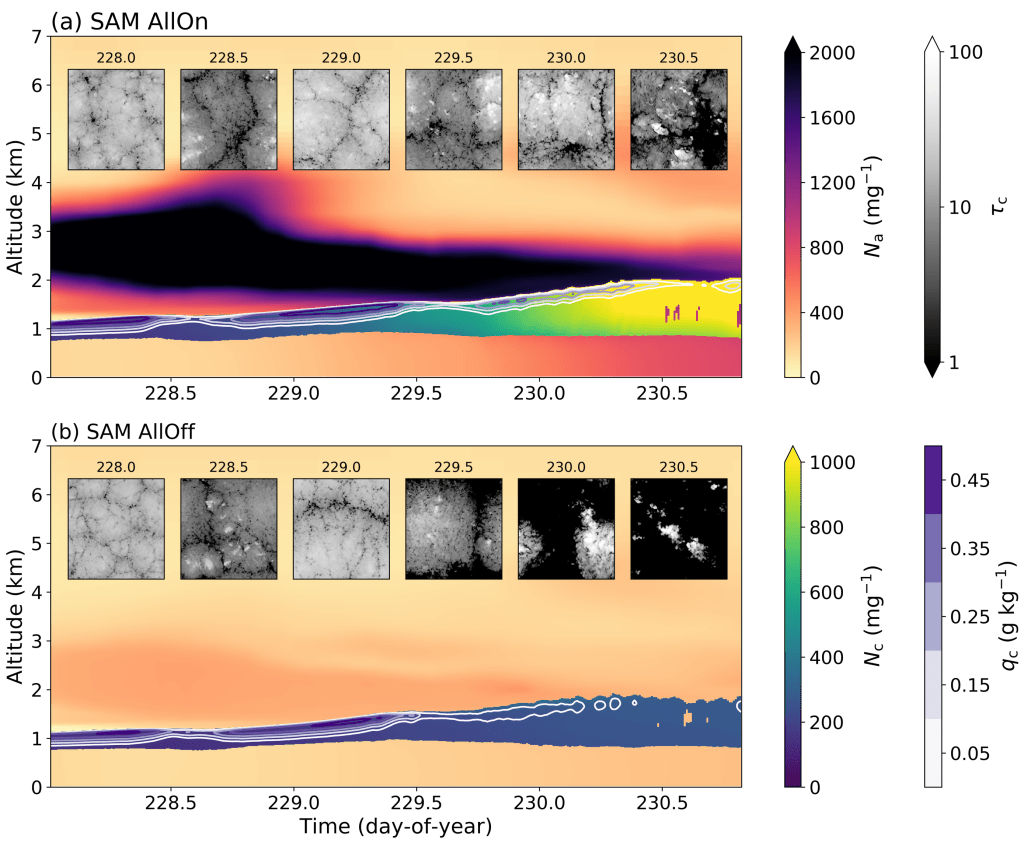
Figure. High-resolution numerical modeling results of clouds affected by smoke (a) and in a counterfactual situation without smoke (b). Warm color shading represents the amount of smoke and cool color shading the number of cloud droplets. Purple contours show the amount of cloud water in the atmosphere. Insets show a top-view of the cloud scene (black is clear skies, white thick clouds).

Smoke from southern Africa blankets the southeast Atlantic Ocean from June-October, overlying a major low-altitude cloud deck. The smoke affects Earth’s radiation budget by absorbing and reflecting radiation directly and by changing cloud properties via their effect on atmospheric temperature and circulation and by seeding additional cloud droplets when they get mixed into the marine boundary layer. Each of these aerosol radiative effects can be large in magnitude but often have offsetting cooling and warming influences.

In our new (open-access!) paper, we investigate smoke effects on the transition between overcast stratocumulus and scattered cumulus clouds along a Lagrangian (air-mass-following) trajectory in regional climate and large eddy simulation (LES) models. We also compare our results with observations from three recent field campaigns that took place in August 2017: ORACLES (NASA), CLARIFY (UK Met Office), and LASIC (US Department of Energy). The case study is set up around a joint ORACLES-CLARIFY flight that took place near Ascension Island on 18 August 2017. Smoke sampled upstream on an ORACLES flight on 15 August 2017 likely entrained into the marine boundary layer later sampled during the joint flight.

The regional climate model is run three times, once including all smoke effects, once excluding smoke entirely, and once with smoke radiative effects turned off. We find that in addition to the expected result of smoke absorption of sunlight increasing temperature in the smoke plume, most of the heating goes toward producing a large decrease in large-scale subsidence over the ocean. When these different smoke effects are used to force an LES that can directly resolve cloud motions, we find that this subsidence effect is more important for cloud evolution than the effect of smoke particles serving as cloud condensation nuclei. Such large-scale “semi-direct” effects of smoke absorption would not have been possible to simulate using a small domain LES model alone.